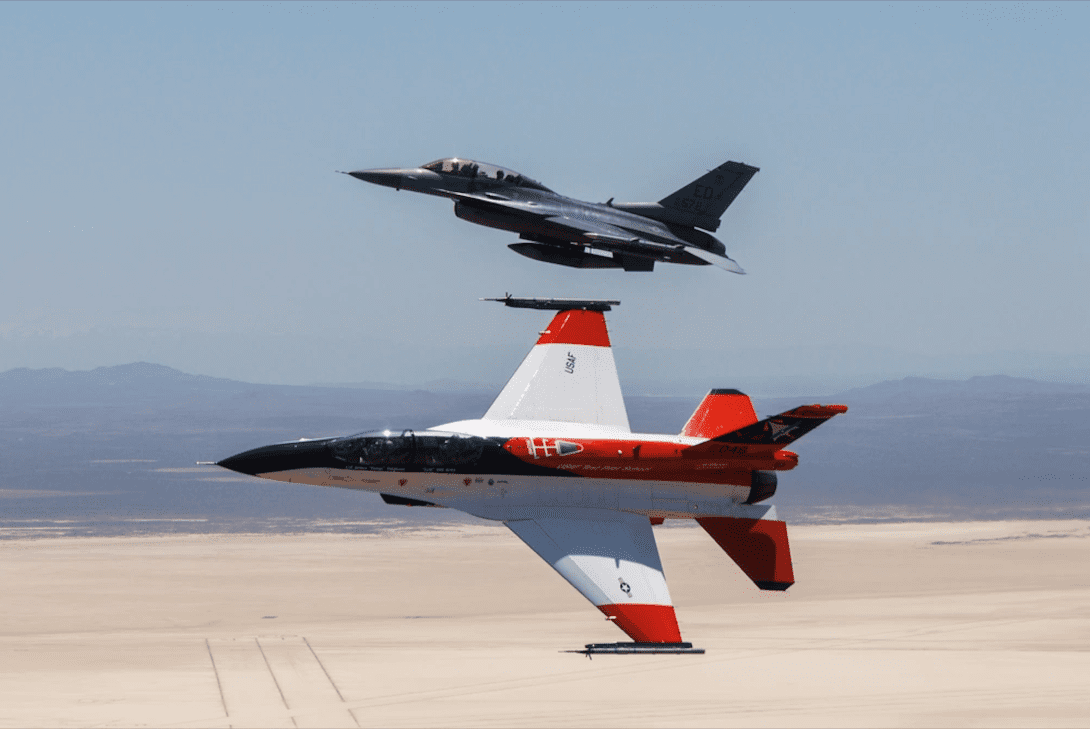
The United States’ Defence Advanced Research Projects Agency (DARPA) has long pushed the boundaries of military technology, and its latest efforts in autonomous aviation are no exception. Building on lessons from earlier experiments where artificial intelligence took the controls of F-16 fighter jets to duel human pilots in the skies, DARPA is now advancing a project that could redefine air combat.
The Artificial Intelligence Reinforcements (AIR) programme seeks to equip future combat aircraft with the ability to operate independently in groups, conducting missions far beyond the line of sight where traditional human oversight becomes impractical. This initiative traces its roots to the Air Combat Evolution (ACE) trials, which demonstrated that AI could handle intense dogfights against experienced aviators. Those tests, conducted in recent years, provided a foundation for scaling up autonomy.
Now, with AIR, DARPA aims to elevate that capability to a new level, creating F-16 variants piloted by AI that can make tactical decisions on their own. These systems would coordinate in multi-aircraft formations, navigating challenges that extend well past visual range, such as long-distance strikes or reconnaissance in contested airspace. Although the AIR programme itself dates back to an initial solicitation issued in 2022, recent developments show it is progressing steadily.
On Wednesday, DARPA awarded an $11.3 million contract modification to Systems & Technology Research (STR), a firm specialising in advanced technologies. This funding, labelled as “Option One” in the Department of Defence’s announcement, actually marks the transition to the programme’s second phase. A DARPA representative confirmed that this step signifies advancement, with STR’s performance in the initial stage earning it a spot in the next round. From an original pool of six contractors, the field will narrow to four as the work intensifies.
STR’s role focuses on one of the programme’s two core technical areas: crafting AI algorithms capable of enabling real-time, distributed tactical operations in environments filled with uncertainty, rapid changes, and complexity—conditions typical of aerial warfare. This involves developing software that allows multiple autonomous jets to communicate and adapt instantaneously, perhaps dividing tasks like suppressing enemy defences or providing mutual cover without constant human input.
The other technical area, as outlined on the programme’s official page, centres on building models that process data quickly and precisely, accounting for unknowns while refining themselves as more information becomes available. Together, these efforts aim to produce reliable AI systems that can evolve in the field, learning from encounters to improve future performance. Crucially, the AIR programme relies on proven hardware rather than inventing new components from scratch. It integrates existing sensors, electronic warfare systems, and weaponry, ensuring compatibility with current fleets.
Testing will unfold in stages, beginning with computer simulations to iron out basic flaws. From there, evaluations will incorporate human operators in a supervisory capacity, allowing for adjustments based on real-world feedback. The ultimate benchmark involves deploying an uncrewed combat aerial vehicle in live scenarios, where the AI must demonstrate its prowess without a pilot on board. Other major players have joined the effort, including Lockheed Martin and BAE Systems, both of which received contracts earlier in the programme. However, their continuation into phase two remains uncertain, as DARPA has stated that the selection process for this stage is still underway.
The agency declined to provide details on other participants, citing the need to maintain confidentiality in such sensitive work. Indeed, much about AIR remains shrouded in secrecy, reflecting the high stakes of autonomous military technology. DARPA has shared little on the specifics of what occurred in phase one or what lies ahead in phase two, beyond noting the shift between them. The upcoming phase is set to span approximately 30 months, during which contractors like STR will refine their contributions through rigorous development and testing. Looking further ahead, the implications of this programme extend into uncharted territory.
If successful, AIR could accelerate the integration of AI into frontline aviation, potentially reducing the risks to human pilots by assigning them to oversight roles or removing them from certain missions altogether. Yet this raises profound questions: at what point might autonomous jets join the growing list of professions displaced by automation?
More provocatively, could an AI system, programmed with ethical guidelines, one day refuse an order—such as a bombing mission—if it deems it unlawful or disproportionate? While such scenarios border on science fiction for now, DARPA’s steady progress suggests they may soon demand serious consideration in defence strategy and policy. As the programme evolves, it promises to shape not just the tools of warfare, but the very nature of decision-making in conflict.