Motorola Solutions and Nokia have joined forces to supply the United Kingdom’s defense community with a containerized, deployable tactical communications network that fuses proven land-mobile radio with modern 4G/5G infrastructure. The partnership pairs Motorola’s field-proven Terrestrial Trunked Radio (TETRA) systems and rugged deployable modules with Nokia’s AirScale family to deliver voice and broadband data to forward areas where commercial networks are absent or unreliable. The companies say the modular units are ruggedized for field use and can be made operational in under 30 minutes.
At its core the solution blends three distinct layers. The first layer is mission-grade voice and narrowband services delivered by Motorola’s TETRA and DIMETRA portfolio; those systems remain the workhorse for secure push-to-talk and group communications in many militaries and emergency services. The second layer is a private 4G/5G domain built around Nokia’s AirScale equipment to carry high-bandwidth traffic such as live video, large sensor data sets, and conferencing. The third is a resilient backhaul based on mobile ad-hoc networking technology from Silvus; that mesh layer extends reach between dispersed forward elements and command nodes and is designed to be self-healing as nodes move or links fail. Together the three layers create a hybrid tactical fabric able to carry both latency-sensitive voice and data-intensive payloads.
Motorola and Nokia are packaging the equipment in rugged containers so entire network stacks travel as single modules. That approach reduces integration time in theater and simplifies logistics; the vendors state the containers can be set up rapidly, which is valuable for expeditionary missions, disaster relief, and surge operations. Motorola’s experience with containerized radio systems is already in service: the company won a framework to supply deployable mission-critical networks to the German Bundeswehr in 2021, delivering container and vehicle-based systems that combined TETRA with LTE to support interoperability with NATO and civilian public safety agencies. The UK modular design advances that idea by integrating native 5G AirScale capabilities alongside MANET backhaul to support modern requirements for bandwidth and sensor fusion.
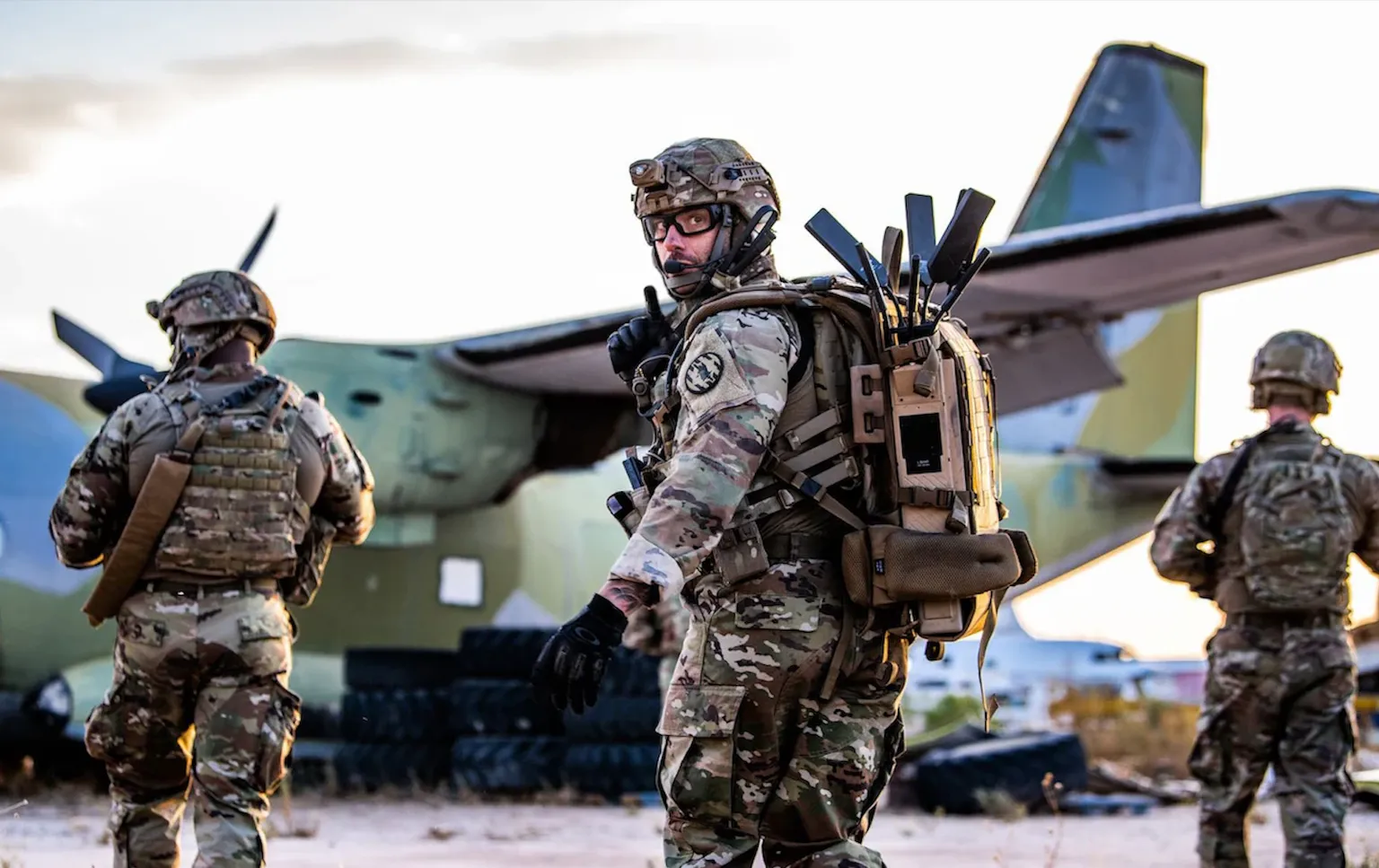
Silvus MANET technology is central to the design when operations extend beyond line-of-sight or conventional fixed infrastructure. High-throughput meshing provides a distributed backhaul that can maintain multi-hop links under mobility and contested terrain conditions. That makes it possible to push long-range video feeds, full-motion ISR sensors, and control channels for uncrewed systems back to command elements without relying solely on vulnerable single-hop links. Motorola’s recent acquisition of Silvus in 2025 folded those MANET capabilities directly into its product portfolio, which shortens the pathway from prototype to integrated field solution.
From a tactical perspective, the combination of TETRA, private 5G and MANET changes how commanders can distribute information. Narrowband radio preserves robust, mission-centric voice and short data; private 5G provides a low-latency pipe for high-definition video and analytics; and MANET maintains connectivity where fixed relays cannot reach. That three-tiered topology supports contemporary force multipliers: persistent video for overwatch, AI-assisted sensor processing at the edge, remote control of unmanned air and ground systems, and real-time collaborative tools for joint and multinational operations. Early coverage of the partnership also notes explicit design intent to secure the data plane and enable integration of AI-enabled sensors in the field.
The collaboration also fits into a broader European trend where telecom vendors and defense primes build bespoke tactical networks for national armed forces. Nokia has recently pursued similar programs with partners on the continent, including a joint effort to develop tactical communications with blackned and Rheinmetall for the German armed forces. Those programs show that defense customers value vendor teams that can pair cellular expertise with defense-grade integration and platform suppliers. For the UK this partnership arrives amid long-running efforts to modernize battlefield communications; the UK’s Morpheus programme, intended to replace legacy Bowman systems, has seen delays and shifting timelines, which increases the utility of interim, modular solutions that can be fielded quickly.
Integration in the field is not without complexity. Tactical systems face spectrum management constraints, the need for hardening against electronic attack, and stringent supply-chain and cybersecurity requirements. Private 5G in deployed settings requires careful radio planning, secure core functions that can operate disconnected from national operator cores, and hardened orchestration to manage QoS when voice, sensor and vehicle control traffic compete. Likewise, any mesh backhaul must be resilient to node loss and graceful in spectrum usage in cluttered electromagnetic environments. Addressing those constraints calls for rigorous testing, field exercises with signal-denied scenarios, and hardened key management; the vendor partnership explicitly frames its offering to meet defence-grade security and operational needs.
Logistics matter as much as radio design. Containerized network modules reduce integration time and create a common unit of lift that can be embarked, airlifted, or driven; prior Motorola systems for Germany used 20-foot ISO container installations and vehicle variants to give commanders options for mobility and footprint. For coalition operations, interoperability with NATO waveforms and public safety networks remains important; the German contract emphasized interoperability with public safety and NATO networks, which provides a template for how the UK solution could be federated with partner systems during multinational missions or domestic emergency response.
For UK defence planners, the Motorola-Nokia offering supplies a pragmatic bridge between legacy mission-critical voice and a future where every forward sensor and platform is a data source. It does not replace long-term procurement programmes outright; rather, it provides a modular, upgradeable architecture that commanders can use while larger, more complex procurement tracks progress. If Norfolk-style brigades require more mobile broadband, or if expeditionary units must operate in peer contestation, a containerized, layered network can be scaled and adapted to mission need. The long-term utility will depend on how the solution performs in contested electromagnetic conditions, its lifecycle costs, and how easily it integrates with doctrine and existing C4I systems.
The industry context also matters for capability sustainment. Motorola’s integration of MANET capability through the Silvus acquisition shortens the innovation cycle for mesh-enabled backhaul. Nokia’s ongoing work on mission-hardened handsets and private 5G cores reflects a push by telecom vendors into defense markets worldwide. Taken together, these moves illustrate how commercial telecom architectures and specialized tactical radio capabilities are converging into fieldable products for armed forces that need both voice resilience and broadband performance.
The Motorola-Nokia collaboration will be watched closely by procurement officials and unit commanders. If the containerized stacks meet claims for rapid setup, interoperability, and robust mesh backhaul under operational stress, they could become a model for how Western militaries combine legacy TETRA voice with cellular-class data in contested or austere environments. The choice for any force will come down to real-world performance, integration with doctrine, and how the system holds up when sensors, drones and human teams rely on it to make time-critical decisions.
Motorola’s and Nokia’s announcements represent an incremental but practical advance in tactical networking. The next steps will be visible in field trials, exercises and any follow-on procurements that prove the system under realistic conditions. For now, the partnership offers a concrete example of how containerized, layered architectures can compress deployment time, extend connectivity, and bring broadband tools to front-line commanders who must fuse many streams of data into a single operational picture.