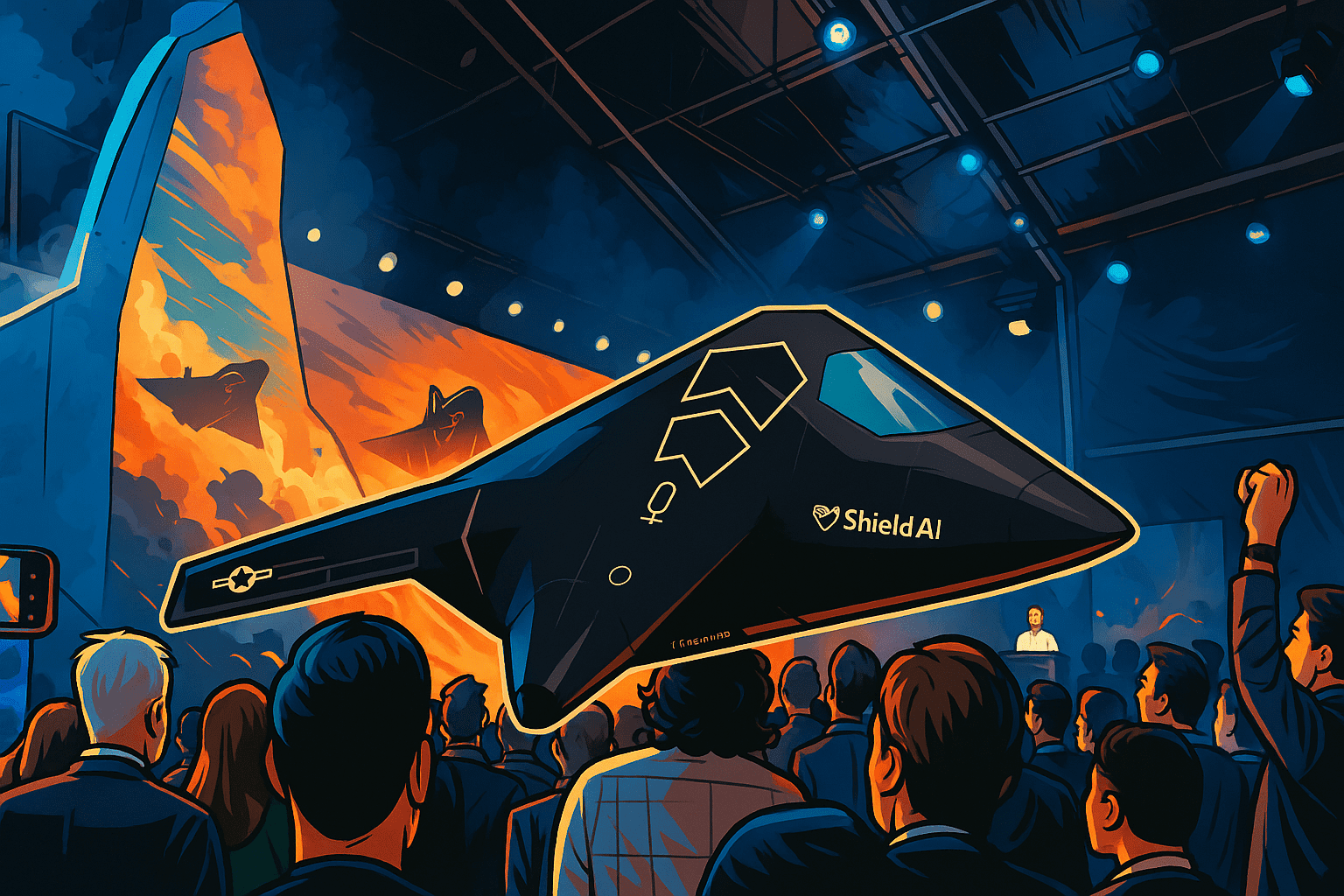
Shield AI, a company known for its autonomy software, is expanding into large-scale uncrewed hardware. On October 22, the firm unveiled the X-BAT, a new jet-powered autonomous aircraft. The X-BAT is classified as a Group 5 Uncrewed Aerial System (UAS), the Pentagon’s designation for its largest uncrewed platforms. The concept’s design centers on two core capabilities: its AI-driven Hivemind pilot and a Vertical Take-Off and Landing (VTOL) system, making it entirely runway-independent.
The X-BAT’s most novel feature is its launch and recovery method. Unlike the conventional wheeled landing gear on the US Air Force’s (USAF) current Collaborative Combat Aircraft (CCA) prototypes, the X-BAT uses a specialized wheeled trailer. For transport, the jet’s wings fold. For launch, a rail system on the trailer orients the aircraft vertically. It then takes off using only its main jet engine and thrust-vectoring nozzle, rotating to horizontal flight after clearing the launcher. The recovery process is equally ambitious: the aircraft will reportedly descend vertically, engine-down, and land back on its launch rail.

The airframe itself is a tailless blended-wing-body with a cranked-kite shape, similar in form to the experimental Northrop Grumman X-47B. Shield AI gives its wingspan as 11.9 meters (39 feet) and length as 7.9 meters. It is designed for high-altitude operations, with a service ceiling of 50,000 feet and a range exceeding 2,000 nautical miles. The design incorporates internal weapons bays and external hardpoints, with renderings showing it capable of carrying large munitions like the AIM-174B, the air-launched variant of the Standard Missile-6.
Propulsion is planned from a “fighter-class” turbofan. While the vendor is unannounced, officials described it as an “F-16 class engine” with an afterburner. The required thrust vectoring capability suggests a powerplant similar to the Pratt & Whitney F100-PW-229, which was tested in the 1990s on the F-15 ACTIVE thrust-vectoring technology demonstrator.
The aircraft will be operated by Shield AI’s Hivemind autonomy software, which the company offers as the system’s core, though officials stated the airframe can support other autonomy systems. This AI pilot is designed for complex, comms-denied operations. Hivemind was previously used to control the X-62A VISTA, a modified F-16D, which successfully engaged a human pilot in a within-visual-range dogfight during a 2024 Defense Advanced Research Projects Agency (DARPA) trial. This autonomy is scaled up from Shield AI’s smaller MQ-35 V-BAT, a tail-sitting VTOL drone already in service with the US Navy.
Shield AI is developing the X-BAT over 18 months, with VTOL demonstrations planned for autumn 2026 and full operational validation by 2028. The company, which is already an autonomy provider for the USAF’s CCA Increment 1, is positioning the X-BAT for future tranches of the program. This runway-independent approach, which company co-founder Brandon Tseng called the “holy grail of deterrence,” directly addresses the vulnerability of fixed airbases.
This VTOL strategy contrasts with the current CCA field. The USAF’s initial CCA prototypes, the General Atomics YFQ-42A and Anduril YFQ-44A, both use conventional runways. Furthermore, Kratos, an early leader in the segment, recently announced it is developing a wheeled landing gear option for its XQ-58A Valkyrie, moving away from rail-launched, parachute-recovered concepts. Shield AI, which will announce its production and engine partners in the coming weeks, argues its multi-role VTOL design strikes the right balance of capability and cost.