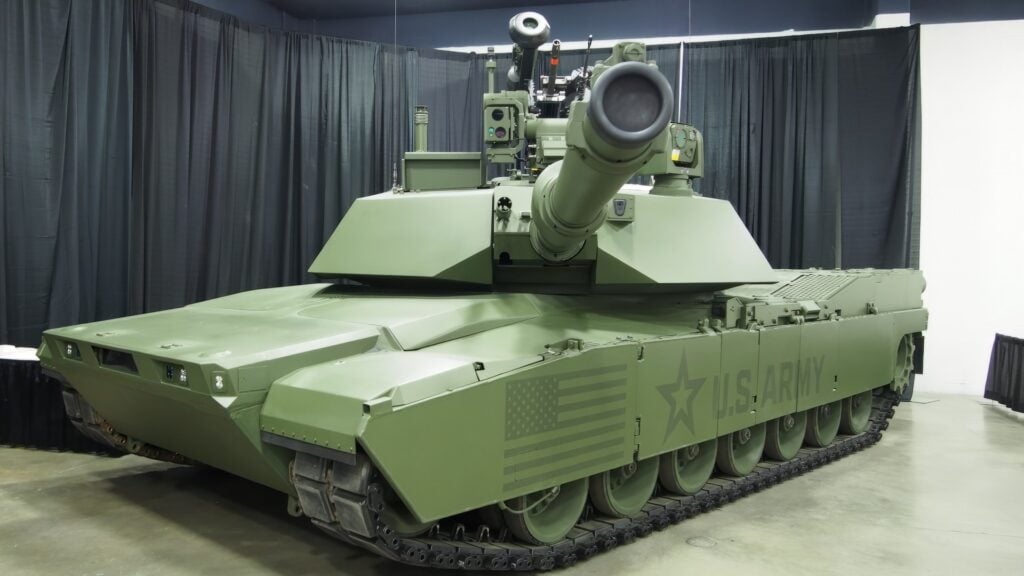
On January 14, 2026, the defense community observed a notable shift in American armored vehicle design during the North American International Auto Show in Detroit. General Dynamics Land Systems (GDLS) displayed an early prototype of the M1E3 Abrams Main Battle Tank (MBT). This public debut, described on US Army social media as a pre-production testbed, serves as a bridge between the legacy of the M1 family and the future of mechanized warfare. The US Army characterized the vehicle as a bold redesign intended to offer enhanced protection, reduced weight, and a minimized logistics footprint through integrated survivability systems.
Crew Survivability and the Citadel Concept
The most substantial change evident in the M1E3 prototype is the reconfiguration of the crew compartment. Moving away from the traditional four-person layout used since the original M1 entered service in 1980, the M1E3 utilizes a three-person crew. The commander, gunner, and driver are all positioned within a well-armored citadel located at the front of the hull. This design choice maximizes protection by concentrating heavy composite armor around the personnel while isolating them from the turret and ammunition storage.
Although the vehicle shown in Detroit did not explicitly detail the exact ergonomics of these positions, the removal of the loader from the turret is a prerequisite for this shift. By housing all personnel in the hull, the Army can lower the overall height of the vehicle and reduce the volume of the space that requires the highest level of protection. This engineering trade-off aims to address the weight spiraling seen in previous variants like the M1A2 System Enhancement Package Version 3 (SEPv3), which exceeded 73 tons.
Lethality and Remote Turret Architecture
The M1E3 features a larger, modular turret designed for remote operation. This remote turret is a ground-breaking addition to the Abrams line; it represents the first time the US Army has integrated such a system on a platform of this scale. While remote turrets have appeared on lighter platforms, such as the Protector Remote Turret 20 (RT20) used on the US Marine Corps Amphibious Combat Vehicle 30 (ACV-30), scaling this technology for a main battle tank involves managing the massive recoil of a 120mm smoothbore gun.
The main armament remains a 120mm smoothbore gun, complete with a thermal sleeve, fume extractor, and muzzle reference system. Unlike previous versions, this gun is fed by a bustle-mounted automatic loader. This mechanical system ensures a consistent rate of fire and allows the ammunition to be stored entirely outside the crew compartment in a blowout-protected compartment. Secondary armament on the prototype includes a 7.62mm coaxial machine gun and a roof-mounted Remote Weapon Station (RWS). The RWS shown appears to be armed with a 40mm automatic grenade launcher and an additional machine gun. Notably, the prototype also features an externally mounted Javelin anti-tank missile system, though the current configuration of the RWS appears to restrict the 360-degree vision of the commander’s panoramic sight.
Weight Reduction and Digital Integration
A core requirement for the M1E3 program is a return to a more deployable weight, with the Army targeting a sub-60-ton profile. To achieve this, engineers have explored a hybrid-electric drivetrain. While the display vehicle reportedly retains a traditional turbine engine as a baseline, the final M1A3 configuration is expected to utilize a hybrid diesel-electric system. This shift would provide a “silent watch” capability, allowing the tank to operate sensors and weapons without the high thermal and acoustic signatures of a running engine.
Digital architecture plays an equally important role. The US Army has emphasized that the M1E3 will feature a digital link to the cloud, allowing for real-time data sharing across the battlefield. This “digital backbone” is supported by an array of new cameras and sensors providing the crew in the hull with 360-degree situational awareness. One of the more unconventional elements shown in Detroit was an electronic game controller, which officials suggested as a potential interface for operating the vehicle’s remote systems. This reflects a broader effort to use intuitive, commercially derived technology to reduce training time and improve operator efficiency.
The concept of a remote-turret Abrams with a hull-seated crew is not entirely new to US research and development. In the 1980s, the Army developed the Tank Test Bed (TTB), which used an M1 hull and a low-profile turret with an automatic loader. While the TTB was never placed into production, it provided the data necessary for the current M1E3 initiative.
Globally, the M1E3 concept mirrors design philosophies seen in other modern armor. The Russian T-14 Armata, revealed in 2015, similarly utilizes an unmanned turret and a crew capsule in the hull. Various design bureaus in the former USSR, including those in Kharkiv, Ukraine, also experimented with these configurations during the late Cold War. However, US officials emphasize that the M1E3 is focused on “no new science,” meaning it prioritizes the integration of mature, high-performance technologies rather than unproven experimental theories.
Future Development and IOC
The vehicle displayed at the Detroit auto show remains an early prototype, or “pre-prototype,” intended to demonstrate potential capabilities rather than a final production model. It lacks essential components planned for the final version, such as a fully integrated Active Protection System (APS) to intercept incoming anti-tank missiles. The Army intends to use this testbed to gather feedback from soldiers before finalizing the design for the M1A3.
Current timelines suggest that the M1E3 will reach Initial Operating Capability (IOC) early in the next decade. Army officials continue to push for an expedited program to replace the aging M1A2 fleet, which has reached the limit of its ability to accept further weight-intensive upgrades. Once type-classified, the “E” prefix will be dropped, and the M1A3 will likely begin production using a mix of new turrets and existing, refurbished hulls. This approach ensures a faster path to fielding while leveraging the established industrial base for the Abrams platform.