When a warship at sea loses a pump component that is no longer available in the supply chain, the traditional answer involves port visits, procurement paperwork, and weeks of waiting. When an aircraft needs a tool that takes six months to acquire through standard channels, squadrons ground assets and manage the gap. In both cases, the platform is down, the crew is waiting, and the mission suffers.
Additive manufacturing, the formal term for what most people call 3D printing, is increasingly the military’s answer to that problem. Across the U.S. Army, Navy, Air Force, and Special Operations Command, a capability that began as an experimental prototyping tool is now producing certified components for some of America’s most capable and expensive platforms, from Arleigh Burke-class destroyers and F-35 fighter jets to Patriot air defence systems and Bradley Fighting Vehicles. And according to the people building and using these systems, the pace of adoption is only accelerating.
“Additive manufacturing is evolving from experimental prototyping to a mission-critical capability,” Barrett Veldsman, founder and CEO of Defend3D, a U.S. Department of Defence supplier of 3D printing solutions, told Shephard Media. “The trajectory is strongly upward. Additive manufacturing is now seen as a strategic enabler for resilience and readiness.”
From Concept to Critical Asset
The breadth of 3D printing’s current military footprint is worth spelling out, because it stretches well beyond the early use cases of printing simple tools and non-structural brackets.
The U.S. Navy’s Southeast Regional Maintenance Centre (SERMC) used additive manufacturing to solve a specific and representative problem: a six-blade chilled water pump cooling rotor used aboard Arleigh Burke-class guided missile destroyers, a component not sold separately in the Navy’s supply system. Traditionally, replacing it meant buying an entirely new pump at substantial cost. SERMC reverse-engineered the original aluminium part, produced a low-cost polymer prototype, validated the design, and printed a functional replacement. The Navy confirmed lead times across its additive programmes fell by 70 percent in 2025 alone (NavSea, January 2026).
The Fleet Readiness Center East (FRCE) produced an O-ring installation tool for all three variants of the F-35 in a two-week window, representing less than 10 percent of the estimated six months the same part would have taken to acquire through conventional procurement. The Fleet Readiness Center Southwest (FRCSW) is printing a button plug for the F/A-18 Hornet multirole fighter. Meanwhile, the Naval Undersea Warfare Centre (NUWC) Division Keyport Innovation Centre (KIC) has been running projects that combine advanced modelling software, 3D printing, laser engraving, and laser cutting to rapidly prototype and produce custom tools and components for submarine-related systems.
The Air Force and Marine Corps have deployed additive manufacturing to recover grounded aircraft faster than conventional supply chains allow. One example now cited in multiple industry reports involved using 3D printing to replace a cockpit cooling duct on an F-15 Eagle, bringing the aircraft back to service months ahead of what traditional procurement would have permitted. Ongoing Air Force initiatives are also producing parts for the C-17 Globemaster III strategic transport and the F-22A Raptor. At Martin State Air National Guard Base in Maryland, the 175th Civil Engineer Squadron has been operating an expeditionary 3D concrete printer to rapidly build fortified field infrastructure, including curved walls that offer superior blast resistance over conventional rectangular designs.
The Army’s Push Forward
The U.S. Army has been the most publicly ambitious of the services in expanding additive manufacturing from maintenance depots to forward-deployed units, and the scale of that ambition has grown considerably over the past year.
Brigadier General Beth A. Behn, Commanding General of the U.S. Army Tank-automotive and Armaments Command (TACOM), described the evolution at last year’s AUSA exhibition in October: “There was a need for parts that were keeping systems down. So we figured out how to reverse engineer, and then produce the part and get it to a unit for temporary use.” That initial battlefield damage repair function has since matured into a formally certified approach in which permanent, qualified components are being produced. The Army is currently producing and certifying parts for the M88 HERCULES (Heavy Equipment Recovery Combat Utility Lift and Evacuation System) under this framework.
The Army’s main additive manufacturing facility is the Rock Island Arsenal-Joint Manufacturing and Technology Centre (RIA-JMTC) in Illinois, which operates 16 different printers capable of working with materials ranging from polymers through to titanium. “We can do things all the way from polymer to titanium,” Behn said.
To accelerate certification of 3D-printed parts for critical platforms, the Army has partnered with the National Institute for Aviation Research (NIR) at Wichita State University. The process involves a full three-dimensional scan of the physical platform, a complete disassembly during which every part is individually scanned, and the creation of verified digital models against which new printed parts can be validated. NIR has already completed this digital twin work for the AH-64D Apache and UH-60 Blackhawk helicopters as well as the M113 Armoured Personnel Carrier. NIR Director Rachael Andrulonis described the workflow: “We take the 2D drawings and use those as our source of truth. Then, we create a full 3D model of every part and of the whole system. When you have a part that is needed, all you need to do is get your 3D model, develop your technical data package, and source it.”
Institutionally, the Army formalised its commitment in Army Directive 2025-14, which authorised the Army Materiel Command (AMC) to use advanced manufacturing methods to improve readiness, established a risk-informed approach to certifying materials and processes, and permitted the use of both the Organic Industrial Base and third-party entities to carry out that work.
The bigger picture is containerised, forward-deployable manufacturing. Army Chief of Staff General Randy A. George told the House Committee on Appropriations in May that AMC “is now developing containerised manufacturing shops and sets so that units can fabricate parts forward and get soldiers the parts they need when they need them.” That concept converts additive manufacturing from a depot-level capability into a tactical one, reducing dependence on the long supply chains that become vulnerabilities in contested environments.
Drones, and Lots of Them
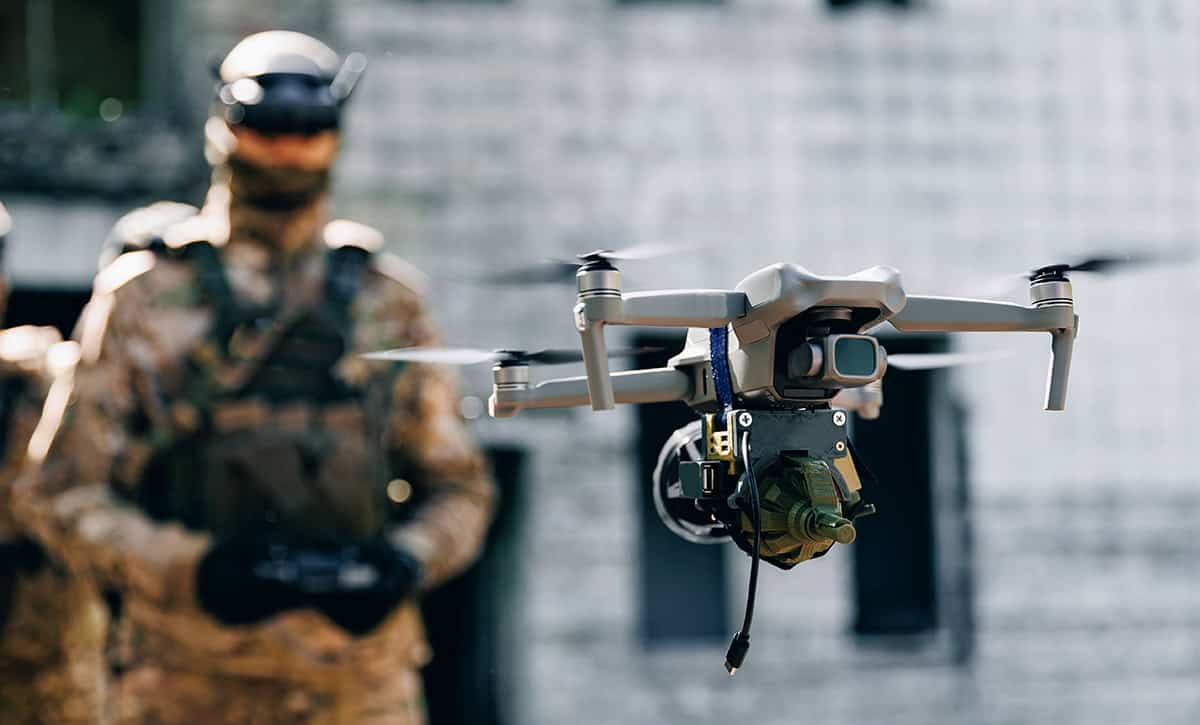
One of the most operationally charged applications of the Army’s additive manufacturing push is drone production. General Behn stated at AUSA that the Army is acquiring a composite-based advanced manufacturing printer with an output target of 10,000 drones per month, with an overall goal of 120,000 drones by the end of Fiscal Year 2026.
That number is striking. It reflects a direct response to the kind of mass attrition warfare that has characterised the drone battle in Ukraine, where both sides have been consuming unmanned systems at a pace that conventional procurement cycles cannot sustain. If the Army can print drones at depot or forward-unit level from digital files, rather than waiting for them to arrive through standard logistics channels, it gains the ability to replenish drone inventories on a timeline driven by operational demand rather than industrial lead times. The Army is already testing portable 3D printing labs in Hawaii that allow soldiers to design, print, and assemble FPV drones on site within hours, an approach that mirrors how Ukraine has been using distributed drone production throughout its conflict with Russia.
The Data Security Problem
The potential of distributed additive manufacturing scales in direct proportion to the security of the data that makes it possible. Every 3D-printed component begins as a Technical Data Package (TDP), a digital file containing the geometry, materials specifications, tolerances, and process parameters needed to produce the part. Those files are the intellectual and operational core of the entire system, and they present a target that adversaries have strong incentives to steal, alter, or corrupt.
Veldsman was direct about the stakes: “Every time a technical data package is downloaded, it becomes a vulnerability. On a ship, at an airbase, or in a forward-deployed unit, that file can be intercepted, altered, or duplicated. One compromised design can cause catastrophic mission failure.”
The DoD’s approach to protecting that data has been evolving. An earlier strategy relied on blockchain methodology to verify file integrity, a system in which technical data sits on local devices for decryption. The weakness of that approach is that a breach exposes the full file. Studies by the Defence Advanced Research Projects Agency (DARPA) demonstrated that data protected this way can be infiltrated, manipulated, or centrally influenced while leaving the underlying file intact and apparently accessible. “Blockchain can record a break-in,” Veldsman said, “but it cannot stop one.”
The current solution, operated through the DoD Digital Manufacturing Exchange (DMX) platform, uses the Defend3D Secure Streaming Transfer Protocol (SSTP). Rather than delivering a complete file to a local device, the SSTP streams encrypted, authenticated design data directly from a secure repository to the printer, in real time, without ever creating a complete local copy. “Nothing is stored on the printer, laptop, or any other type of device locally,” Veldsman explained. “No complete file ever exists, and nothing remains for an attacker to steal or manipulate.” It is the difference between handing someone a manuscript and reading it to them over a secure line: in the second case, there is nothing to take away.
Active Procurement and Pending Legislation
The pace of acquisition activity in 2025-2026 shows how quickly institutional demand has grown. The U.S. Army Mission and Installation Contracting Command (MICC) is seeking a system capable of producing large, real-scale parts with complex internal geometries, using ruggedised materials including ABS, polycarbonate, water-soluble support filaments, and more than 40 other printable materials. The Naval Facilities Engineering Systems Command (NAVFAC) is conducting market research into 3D printed construction technologies for vertical structures including barracks, offices, warehouses, and utility buildings, assessing not just cost and timelines but environmental performance and seismic resilience. USSOCOM is seeking a platform providing in-house 3D printing, mechanical tooling, and computer processing capabilities to support rapid prototyping and laboratory experimentation.
On the funding side, the DoD’s FY2026 budget request allocated $3.3 billion for additive manufacturing-related projects, an 83 percent increase over the previous year, driven by two priorities: new product development and the sustainment of a vast inventory of ageing legacy vehicles and equipment (SME/RAPID+TCT, 2026). Secretary of the Army Dan Driscoll has explicitly directed that advanced manufacturing, including 3D printing, be extended to operational units by the end of 2026 (Military Additive Manufacturing Summit, April 2025).
At the legislative level, the Defense Industrial Base Advanced Manufacturing Enhancement Act, introduced on June 2, 2026, by Representative Chris Deluzio, would amend Section 1842 of the FY2026 National Defence Authorisation Act (NDAA) to require the Pentagon to identify additive manufacturing solutions for critical readiness items, establishing a formal process for addressing supply-chain shortages that currently affect platform availability (Military.com, June 2026).
The Road Ahead: Interoperability, AI, and the Digital Thread
For Veldsman and others operating at the cutting edge of military additive manufacturing, the next generation of systems needs to go further than current technology allows. The capabilities required will include secure streaming, real-time verification, and fully traceable digital threads that connect every decision in a part’s lifecycle, from design to manufacture to installation.
Critically, those systems need to function under the same conditions that make them most necessary: low-bandwidth communications, contested networks, and environments far from established industrial infrastructure. A containerised manufacturing shop that cannot maintain a secure data link to its design repository is considerably less useful than one that can maintain it under jamming or communications degradation.
“Interoperability is also critical,” Veldsman stressed. “Defence ecosystems involve multiple original equipment manufacturers, regions, and legacy systems. They need one secure digital thread that unites them all, ensuring traceability and sovereignty across every printer, base, and mission.”
The integration of AI into additive manufacturing workflows, already underway in several programmes, points toward a future in which AI tools assist in reverse-engineering legacy components, optimising designs for printability and structural performance, and flagging data integrity issues before a compromised file reaches a printer. Paired with the kind of autonomous battlefield logistics that USSOCOM and Army Futures Command are developing, forward-deployable manufacturing nodes linked to AI-curated design libraries represent a genuinely new model of military supply chain resilience.
Final Thoughts
The argument for additive manufacturing in defence has always been intuitive: if you can print a part where and when you need it, you are no longer hostage to the distances, lead times, and supply-chain vulnerabilities that conventional logistics create. What is changing now is that the argument has moved from intuition to demonstrated operational reality, across multiple services, on multiple critical platforms, under a funding commitment that has grown by an order of magnitude in two years.
The remaining challenges are real. Certification of printed metal parts for flight-critical applications is still slow and expensive. The data security problem, while advancing toward a solution with SSTP, is not yet fully solved at operational scale. And expanding the capability from depots to forward-deployed units in contested environments with degraded communications will require technology and doctrine that is still being developed.
But the trajectory is clear. The U.S. military is no longer asking whether 3D printing belongs in defence. It is asking how fast it can be pushed forward, how securely the data supporting it can be protected, and how many of the 120,000 drones it wants by the end of this year will be rolling off a printer rather than a conventional production line.