When Russia’s air defence planners drew up their order of battle before 2022, neither the A-50U Mainstay airborne early warning aircraft nor the Su-57 Felon, the country’s only stealth fighter, was ever meant to spend its flight hours chasing $50,000 Ukrainian attack drones. The A-50U was built to hunt enemy fighters and cruise missiles from hundreds of kilometres away, feeding targeting data into Russia’s integrated air defence network. The Su-57 was built and marketed, at enormous cost and after decades of delay, as Russia’s answer to the F-22 and F-35, a low-observable multirole fighter meant to contest the skies against NATO’s most capable aircraft. Neither aircraft was designed with the humble, slow-flying, one-way attack drone in mind.
Yet new reporting and open-source video from July 2026 show both aircraft now doing exactly that. It is a sign, more than almost anything else to emerge from the war in recent months, of just how much strain Ukraine’s long-range drone campaign has placed on Russia’s air defence network, and how far Moscow is now willing to reach into its most valuable and limited assets to plug the gap.
The Strike That Exposed the Gap: Omsk
The immediate trigger for this shift was a single, remarkable Ukrainian strike. On July 6, 2026, Ukrainian long-range drones struck the Omsk oil refinery in southwestern Siberia, Russia’s largest refinery and a facility that accounts for roughly 10 percent of the country’s total refining capacity. Reuters and Ukraine’s own General Staff put the distance flown by the attacking drones at approximately 2,700 to 3,000 kilometres from Ukrainian-held territory, close to Russia’s border with Kazakhstan and, notably, the first time the war had reached a target beyond the Ural Mountains. Satellite imagery reviewed by the OSINT outlet Militarnyi confirmed at least four separate impact points on the refinery’s ELOU-AVT-11 crude processing unit, the plant’s largest, with damage visible to process columns, pipe racks, and overhead pipelines connecting them.
The strike was carried out using an upgraded variant of Fire Point’s FP-1 loitering munition, redesigned with a new trapezoidal wing that reduces drag at cruising speed and creates room for additional fuel, extending the drone’s range to somewhere between 2,700 and 3,400 kilometres depending on payload. At a unit cost reported to be around $50,000, the FP-1(ER) is a strike weapon roughly two orders of magnitude cheaper than the cruise missiles and precision-guided munitions Western militaries typically use for comparable strikes. Fire Point CEO Iryna Terekh made the significance of the target explicit in a public statement: the Omsk refinery had remained one of only two refineries among Russia’s top ten producers never previously hit by a Ukrainian drone, the other being the Angarsk Petrochemical Company in Irkutsk Oblast, both located beyond the Urals and previously considered safely out of reach.
What happened, or rather did not happen, on the way to the target is arguably more revealing than the strike itself. According to the OSINT account DroneBomber, the Russian city of Kazan marked the last point along the drones’ flight path where Russian forces still had “any meaningful air defence coverage and radar tracking.” Past Kazan, DroneBomber noted, “all information about them disappeared,” with Russian Telegram channels describing the drones simply as “lost.” For a country that has spent decades building one of the most extensive integrated air defence networks in the world, watching a formation of slow-moving propeller-driven drones vanish from radar coverage for the better part of a thousand kilometres is a striking admission of a coverage gap.
Why Russia’s Air Defence Network Is Cracking
Russia still fields, on paper, one of the most formidable layered air defence networks anywhere on earth, built around systems like the S-400 and S-300, medium-range Buk batteries, and short-range Pantsir and Tor systems. But a network’s theoretical capability and its practical, day-to-day coverage are two different things, and the gap between them has been widening.
Two pressures are doing most of the damage. The first is straightforward attrition. Ukraine has been destroying or damaging Russian air defence components, Buk, Tor, Pantsir, and S-400/S-300 batteries among them, at a pace that has been described as near-daily across multiple fronts, using a mix of long-range drones, precision strikes, and increasingly sophisticated targeting of the radar and command vehicles that make each system function as an integrated whole rather than a collection of independent launchers. Every battery destroyed is a battery that cannot be repositioned to cover the next threat axis.
The second pressure is geographic dispersion. Ukraine has been steadily widening the range of targets it strikes across Russian territory, forcing what remains of the country’s air defence inventory to be spread across an enormous and growing area rather than concentrated around a predictable set of priority targets. Compounding the problem, Ukraine has continued to strike Moscow and St. Petersburg, targets Russian leadership treats as politically unacceptable to leave undefended regardless of the operational cost. Every additional battery redeployed to shore up the capital’s skies is one fewer battery available on the actual front line, or guarding the strategic industrial and energy infrastructure, like the Omsk refinery, that the network was originally built to protect.
The result is a network that looks formidable in aggregate but is, in practice, stretched thin enough that a determined, long-range drone strike can find genuine gaps in coverage. Kazan sitting at the edge of “meaningful” radar tracking, deep inside Russia’s own territory, is the clearest illustration of that stretching yet documented.
Tasking the A-50U: A Flying Quarterback for a Job It Wasn’t Built For
Russia’s response to that gap has involved reaching for one of its scarcest and most valuable aircraft types: the A-50U Mainstay, an airborne early warning and control (AEW&C) aircraft built on the Ilyushin Il-76 transport airframe and modernised with new radar and mission systems.

The fleet Russia has to work with is small and has been shrinking steadily throughout the war. The Russian Aerospace Forces received eight upgraded A-50U aircraft in total before the full-scale invasion. Losses since then have been significant relative to that small starting number. The first A-50U, tail number Red 41, was damaged in a Ukrainian FPV drone attack on Machulishchy airbase in Belarus in February 2023 and reportedly never returned to service. A second aircraft, believed to be Red 37, was shot down over the Sea of Azov on January 14, 2024, an incident the U.S. Army later attributed to a Patriot air defence “SAMbush.” A third, Red 42, was destroyed over Russia’s Krasnodar region roughly five weeks later, on February 23, 2024. A fourth aircraft was reportedly struck by FPV drones during Ukraine’s audacious Operation Spiderweb strikes on June 1, 2025, alongside a formation of Tu-95 and Tu-22M bombers destroyed in the same operation. The British Ministry of Defence assessed in February 2023 that Russia likely had around six A-50Us remaining in service; by mid-2026, the Ukrainian open-source outlet Defense Express was assessing the figure at “no more than four” aircraft capable of regular flight operations, even accounting for a newly delivered replacement airframe spotted in late May 2026.
That is an extraordinarily small number for an aircraft the entire Russian integrated air defence and air-to-air targeting architecture depends on. The A-50U’s core function is to see what ground-based radar physically cannot. Because radar energy travels in straight lines and the earth curves away beneath it, a ground station’s ability to detect a low-flying target shrinks rapidly with distance, a phenomenon controllers call the radar horizon. An AEW&C aircraft flying at altitude sidesteps that limitation entirely, and the A-50U’s improvements over the baseline A-50 are considerable: published figures put its detection range against low-altitude targets, such as the GBU-39 small diameter bomb or an F-16 flying close to terrain, at around 270 kilometres, extending to 450 to 500 kilometres against high-altitude targets, and it can reportedly track up to 150 aerial targets simultaneously at ranges out to nearly 600 kilometres. For a slow, low-flying Ukrainian attack drone that a ground radar might only pick up at 30 or 40 kilometres, if at all, an A-50U orbiting well behind the lines can potentially spot the same target from roughly 200 miles away, exactly the kind of stand-off warning window that ground-based sensors alone cannot provide.
That capability is what makes the A-50U valuable as what amounts to a flying quarterback for drone defence, even though shooting down slow attack drones was never its design intent. With Ukraine now firing drones across ranges that make flying an A-50U anywhere near the actual front line unacceptably dangerous, given the aircraft’s history of losses to exactly that kind of proximity, the aircraft has instead been tasked from further back, using its long-range radar and extensive communications suite to detect inbound drone raids early and cue other assets, crucially including the Su-57, onto the threat. Open-source footage from July 7, 2026, purportedly showed an A-50U operating over Omsk during the drone attack there, though even that intervention reportedly failed to prevent the strike from reaching its target.
The complication Russia faces is that the threats it is now trying to use the A-50U against are not conveniently high and fast. Ukraine’s family of long-range strike weapons, including its FP-series drones and the substantially larger FP-5 Flamingo cruise missile, a 3,000-kilometre-range weapon with a 1,150-kilogram warhead, are deliberately designed to fly low, hugging terrain to exploit exactly the radar horizon problem the A-50U exists to solve. It is worth a small technical clarification here: the missile most commonly associated with the Flamingo name is specifically the FP-5, while the newer FP-9 is a separate, larger ballistic weapon in Fire Point’s expanding family, reportedly carrying an 800-kilogram warhead to ranges of around 855 kilometres via a high-altitude ballistic trajectory rather than a low-altitude cruise profile. Whichever specific weapon is involved, the broader point holds: Ukraine’s long-range strike doctrine is built around denying Russian radar, airborne or ground-based, an easy look, which is precisely why even a capable AEW&C asset struggles to guarantee an intercept.
The Su-57 Felon Becomes a Drone Hunter
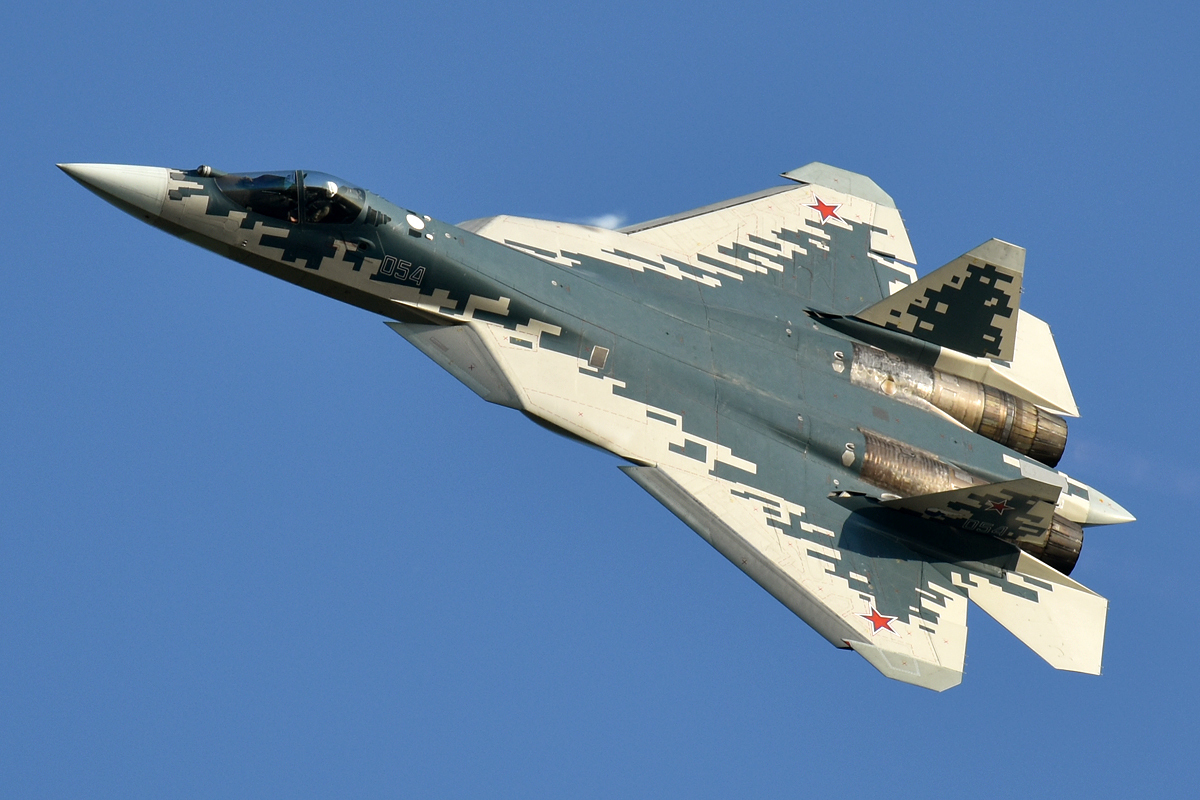
The other half of this story is the Su-57, and it is, if anything, the more surprising development. In early July 2026, the defence outlet The War Zone published imagery of a Russian Su-57 carrying an unusual external weapons load: a pair of short-range R-73/R-74 air-to-air missiles mounted on underwing pylons, alongside what appeared to be a modified targeting pod, likely a variant of the 101KS-N Atoll electro-optical system, mounted beneath the left engine nacelle. “We may just have gotten our first close look at a Su-57 equipped to counter the Ukrainian kamikaze drones and cruise missiles,” The War Zone wrote at the time, noting that targeting pods, though originally developed for air-to-ground work, are also genuinely useful for visual identification and passive tracking of small aerial targets at range, a function that matters considerably when trying to positively identify a drone rather than a friendly aircraft before firing.
About a week after that imagery emerged, video began circulating that appeared to confirm the theory in action. The OSINT account MAKS 26 posted footage on July 6, 2026, captioned: “Su-57 in the sky of Omsk hunts Ukrainian drones. Only one shot down. All the others hit the target.” Taken at face value, that is a strikingly poor intercept rate for one of the most expensive and technologically ambitious fighter aircraft Russia has ever produced, and it fits a broader pattern that has trailed the Su-57 throughout its combat career: an aircraft surrounded by considerable prestige and expectation that has, in practice, underperformed against more modest but more mature platforms.
The numbers help explain why. Despite the Kremlin’s public target of 76 operational Su-57s by 2027 to 2028, independent tracking suggests fewer than three dozen airframes have actually been produced as of 2026, a production shortfall that has left the type a genuinely scarce asset rather than a mass-fielded fighter. Against that backdrop, it is the older, thoroughly proven Su-35 that continues to shoulder the bulk of Russia’s air superiority workload. Russian sources claimed a Su-35 downed a Ukrainian MiG-29 in a beyond-visual-range engagement during the night of June 26 to 27, 2026, reportedly using an R-37M long-range air-to-air missile fired from around 190 kilometres away while operating safely inside Russian-controlled airspace, a tactic that lets the Su-35 employ stand-off missiles without exposing itself to Ukraine’s own increasingly capable air defences and, since July 2026, its F-16s.
Nor is this the Su-57’s first brush with the anti-drone mission, albeit under considerably stranger circumstances. In October 2024, a Su-57 escorting Russia’s S-70 Okhotnik stealth combat drone on a test flight near Kostiantynivka in Donetsk Oblast reportedly fired on and destroyed its own wingman after the Okhotnik suffered a technical malfunction and lost contact with its ground controller, veering toward Ukrainian-held territory. Rather than risk one of only a handful of Okhotnik prototypes falling into Ukrainian hands largely intact, ground controllers are reported to have ordered the accompanying Su-57 pilot to bring it down, reportedly with a short-range heat-seeking missile. It remains one of the more unusual entries in the Su-57’s combat record, and a reminder that this has never been a straightforward aircraft to operate.
Ukraine, for its part, has not left the Su-57 fleet entirely alone even on the ground. Long-range drone strikes reportedly damaged Su-57 airframes at Akhtubinsk in 2024 and again at Shagol airbase in Chelyabinsk Oblast, some 1,700 kilometres from the border, in April 2026. The open-source loss-tracking project Oryx, known for requiring photographic or video evidence before logging any claimed loss or damage, lists one Su-57 as visually confirmed damaged.
Set against that backdrop, Russia’s overall pattern of employing the Su-57 has been notably cautious. For most of the war it has been used to fire stand-off weapons, such as Kh-69 cruise missiles, from deep within safe Russian airspace, along with a limited amount of air-to-air work, rather than being pushed into the kind of close-in, high-risk engagements that would put one of Russia’s scarcest and most symbolically important aircraft at genuine risk. Tasking it, even occasionally, with the distinctly unglamorous job of shooting down cheap propeller-driven attack drones is a measure of just how urgent Russia’s air defence gap has become, not a sign that the aircraft’s role is being deliberately expanded.
The Risk of Using Prestige Assets Against Cheap Threats
There is a broader pattern worth drawing out here, one that extends beyond the A-50U and Su-57 specifically. Tasking exquisite, low-density, high-value crewed aircraft against a mass, low-cost drone threat is an inherently uncomfortable trade, and not only because it is expensive. It also introduces new categories of risk that simply do not exist when the interceptor is a ground-based gun or a dedicated counter-UAS system.
Russia’s own forces have already demonstrated one version of that risk. A Russian Ka-52 Alligator attack helicopter was reportedly shot down by friendly fire in early July 2026 while attempting to intercept Ukrainian drones, a stark illustration of how chaotic and dangerous close-in engagements against small, fast-moving, hard-to-classify targets can become, even for the side doing the shooting down. As Future Military Technologies has covered in looking at how Western militaries are approaching the same underlying problem, the industry consensus for defeating mass drone raids has increasingly moved toward purpose-built, AI-curated kill chains that pair cheap, dedicated interceptors with automated battle management software specifically because sending expensive crewed platforms after cheap drones is a poor economic and operational trade at scale. Lockheed Martin’s recent counter-drone kill chain, built around AI battle management software cueing a JAGM missile fired from a low-cost containerised launcher, is explicitly designed around that logic: match the cost and risk profile of the interceptor to the cost and risk profile of the threat, rather than the reverse.
Russia, lacking a comparable mature, scaled counter-drone architecture of its own, appears to be making do with what it has, which in this case means occasionally borrowing its scarcest air assets for a mission neither was designed for. It is a contrast worth setting against Britain’s own recent push toward AI-enabled, machine-speed targeting and battle management, where the emphasis has been on building software architecture fast enough to outpace the threat rather than relying on a shrinking pool of legacy high-value platforms improvised into a new role.
It is also a reminder of just how much strain Ukraine’s long-range strike campaign, waged with weapons that individually cost a fraction of a single air-to-air missile, let alone a fighter jet or an AEW&C aircraft, has placed on the broader logic of Russian air defence. As we discussed at length in our overview of the technologies shaping 2026’s battlefields, the mass-precision drone has fundamentally altered the economics of the modern conflict, and Russia’s improvised use of its A-50U and Su-57 fleets against exactly that threat is one of the clearest illustrations yet of a military adapting, awkwardly and expensively, to a problem it did not anticipate having to solve with the assets it built for an entirely different kind of war.
Forced to shoot down drones
Neither the A-50U nor the Su-57 was ever meant to spend meaningful flight hours chasing $50,000 drones across Siberian skies. That both aircraft now appear to be doing exactly that says less about either platform’s design and more about the state of the network they are being asked to reinforce. A country that once fielded one of the densest, most layered air defence systems in the world is now watching drone formations disappear from radar coverage for hundreds of kilometres at a stretch, and responding by pulling its scarcest, most expensive, most symbolically important aircraft into a role that exposes them to exactly the kind of attrition Russia can least afford to absorb.
Whether this becomes a settled pattern or a stopgap measure abandoned once (or if) Russia fields a more purpose-built counter-drone architecture of its own is not yet clear. What is clear is that the arithmetic Ukraine has been quietly proving since 2022, that a sufficiently determined, sufficiently cheap, sufficiently long-ranged drone campaign can force a much larger and better-resourced adversary into uncomfortable, improvised choices, has claimed two more data points in the A-50U and the Su-57 Felon.