


Anti-drone technology means the tools, sensors, tactics, and networked systems used to detect, identify, track, and defeat hostile or unauthorized unmanned aircraft. It combines radar, radio-frequency sensing, electro-optical and infrared cameras, acoustic arrays, and kinetic and non-kinetic defeat methods into layered defenses that protect airports, urban areas, critical infrastructure, and military forces.
This guide explains how anti-drone technology works, why layered defenses matter, which sensor and defeat approaches are most common, and what recent conflicts and procurement trends reveal about the direction of the market and doctrine. It uses real-world examples and recent industry reporting so readers get a practical, current context for planning, acquisition, and training.
Why anti-drone technology is now mission-critical
Drones changed the operational environment quickly; they are cheap, adaptable, and able to perform surveillance, precision strike, and logistics missions. Consequently, defending airspace against hostile small unmanned aircraft moved from an occasional policing task into a routine security requirement for militaries, airports, and critical infrastructure. In many cases, actors field hundreds or thousands of systems in waves, which demands scalable anti-drone technology rather than single-point defenses. For example, battlefield reporting shows how drones have reshaped frontline reconnaissance and strike operations in Ukraine, forcing both sides to invest in counter-UAS tools and tactics.
Market indicators reflect this operational shift; independent reports estimate rapid growth in the anti-drone technology market, with compound annual growth rates that suggest rising procurement by governments and commercial stakeholders worldwide. Procurement and research dollars are moving into detection, automated classification, electronic defeat, and kinetic interceptors.
The layered defense model: why one system is rarely enough
Anti-drone technology succeeds when it is layered. A single sensor or a single defeat technique is usually inadequate. Instead, resilient defenses combine detection, classification, tracking, and defeat; each layer backs up the others so that attackers cannot exploit a single weakness.
Typical layered architecture:
- Wide-area detection using primary radars and passive RF sensors to establish initial tracks.
- Local detection and classification using electro-optical/infrared (EO/IR) cameras, acoustic arrays, and specialized short-range radars.
- Command and control that fuses sensor inputs, applies automated classification, and presents operators with curated engagement options.
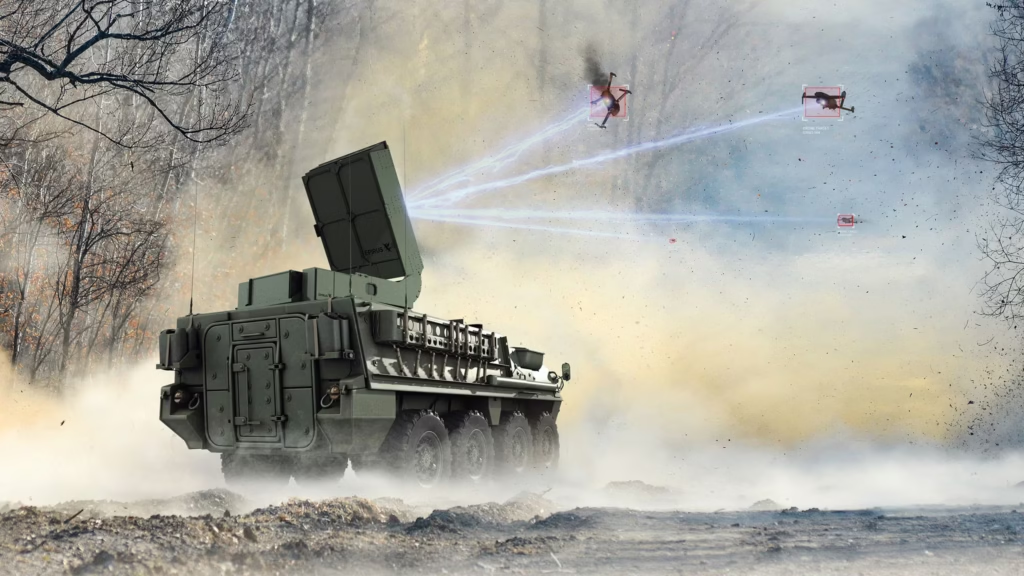
- Defeat options spanning electronic warfare, soft-kill measures such as jamming and spoofing, and hard-kill measures such as interceptor drones, projectiles, or directed-energy systems.
Layering improves resilience; if GPS is denied, an EO/IR sensor can still identify a target, and if an RF link is jammed, interceptor drones or kinetic options can provide a physical solution. Modern anti-drone technology vendors emphasise sensor fusion and automated decision support because scale and speed matter when small drones arrive in groups.
How anti-drone technology detects and classifies threats
Radar: the classic workhorse
Radars adapted for small drones operate with higher sensitivity and faster update rates than traditional air-surveillance radars. They provide early warning and track bearings; however, small low-RCS drones flying low and slow can be masked by ground clutter. Therefore, anti-drone technology often uses radar tuned specifically for low-altitude, slow-moving targets.
Radio-frequency (RF) sensing: exploit the control link
Many commercial drones rely on RF telemetry and control links; RF detectors can pick up controller transmissions, video feeds, and GNSS emissions. RF sensing is valuable because it directly reveals operator activity and may allow geolocation of the controller. That said, autopilot-capable or stealthy drones that use satellite links or custom encrypted channels are harder to detect with RF alone.
Electro-optical and infrared (EO/IR) cameras: visual confirmation
Visible and infrared cameras provide classification and positive identification. They are essential for minimizing false positives; operators often require visual confirmation before initiating defeat measures in populated areas. EO/IR systems work well in daylight or clear conditions, and thermal imagers extend capability at night.
Acoustic systems: cheap and mobile detection
Microphone arrays can listen for rotor noise and classify signatures using machine learning. Acoustic systems are inexpensive and mobile; however, they are sensitive to environmental noise and wind.
Sensor fusion and automated classification
The most effective anti-drone technology solutions fuse radar, RF, EO/IR, and acoustic inputs to produce a single track and classification estimate. Machine-learning models accelerate classification, yet these models must be validated against adversarial conditions; real-world clutter, spoofing, and sensor degradation can cause errors. Vendors increasingly present AI-driven fusion as a selling point, but operational testing remains the reliability bottleneck.
How anti-drone technology defeats threats: non-kinetic and kinetic options
Anti-drone technology deploys a mix of non-kinetic and kinetic defeat methods. Choice depends on rules of engagement, civilian risk, platform availability, and the particular threat type.
Electronic defeat: jamming and spoofing
Jamming blocks control and navigation signals; spoofing feeds false GNSS or telemetry. These are attractive because they avoid falling debris and collateral damage. Yet non-kinetic options have limits; jamming can affect nearby friendly or civilian services and may be illegal in some jurisdictions without explicit authority. Advanced drones with inertial navigation or autonomous mission profiles can continue to operate even when the link is jammed, so jamming is often one part of a multi-tool approach.
RF interdiction and controller take-down
Some anti-drone technology packages attempt to geolocate the operator and either jam the uplink selectively or, where lawful, enable local security forces to arrest or disrupt the operator. Geolocation requires accurate RF direction-finding and usually benefits from multiple sensors.
Kinetic interceptors: projectiles, nets, and interceptor UAVs
Hard-kill options include small cannon rounds, shotguns with specialized loads, net guns, and interceptor drones designed to physically collide with or capture threats. Interceptor UAVs are growing in use because they can pursue and engage targets at standoff distances; however, they must be fast and agile to deal with FPV and swarm threats. Ukraine’s increasing use of interceptor drones demonstrates a practical, scalable approach for battlefield scenarios where kinetic defeat is acceptable.
Directed energy: lasers and high-power microwaves
Directed energy weapons offer rapid engagement at low marginal cost per shot and minimal debris; they are promising for fixed sites and naval platforms. Yet practical issues remain: power supply, atmospheric effects, and cooling. Some navies and militaries are accelerating field tests for laser systems as anti-drone technology matures.

What lessons recent conflicts teach about anti-drone technology
Real conflict environments are the harshest tests for anti-drone technology. Ukraine provided extensive operational lessons; forces encountered massed drone attacks, improvised loitering munitions, and waves of low-cost ISR drones. In response, multiple nations and vendors accelerated fielding of counter-UAS technologies and adapted tactics such as layered detection, mobile EW teams, and interceptor drones. NATO has run multinational anti-drone exercises that included Ukrainian participation to capture battlefield experience and to test interoperability among allied systems.
Additionally, Europe and NATO are now discussing larger-scale “drone wall” concepts and cross-border coordination to protect critical borders and urban centers; these initiatives show how anti-drone technology is moving from point solutions to regionally integrated architectures.
Emerging threat types and how anti-drone technology must adapt
Fast jet-powered and high-speed loiterers
Adversaries are iterating designs; newer jet-propelled loitering munitions and faster FPV attackers reduce reaction time. Defeat requires faster sensors, automated target classification, and either rapid interceptor launch or persistent hard-kill assets. Recent reporting warns of jet-powered threats that demand upgraded interceptor capability and revised tactical planning.
Swarms and massed attacks
Swarms require scalable anti-drone technology; one-shot solutions fail when dozens or hundreds of drones arrive. Effective counters are layered; soft-kill measures can disrupt many low-cost drones at once, while cost-effective kinetic options handle survivors. AI-driven automation helps manage engagement sequencing under high tempo.
Multi-domain coordination and hybrid threats
Attackers mix GNSS resistance, custom data links, and decoys. Anti-drone technology must therefore integrate cyber, EW, and physical defense responses. For example, intentional reduction of mobile network quality has been considered in some conflicts to deny commercial networks as command vectors; defenders need options that work when parts of the civilian comms fabric are degraded.
Vendor landscape and procurement trends
The anti-drone technology market is crowded and expanding quickly. Established defense primes and specialist firms both compete; governments often seek modular systems that can be fielded rapidly.
Notable trends:
- Rapid procurement and modularity: military forces are buying modular, expeditionary systems that can be deployed quickly and reconfigured between missions. Vendors emphasise plug-and-play sensors and modular EW payloads.
- Commercial partnerships: firms originally focused on security and civil markets now supply military customers; many industry offerings are software-focused, enabling quicker updates.
- Growth and investment: market research estimates strong growth for anti-drone technology spending through 2030 as threats grow and civil authorities adopt C-UAS for airports and events.
- Notable contracts: specialist firms have won major deals to supply handheld and medium-range counter-UAS systems to European and allied customers; these awards accelerate production and fielding timelines.
Taken together, these trends show procurement moving from experimental buys toward larger scale acquisition programs.
Case study: Ukraine’s pragmatic use of anti-drone technology
Ukraine’s battlefield experience demonstrates pragmatic mixes of anti-drone technology and tactics. Forces combined low-cost jammers and RF detectors with custom interceptor drones and human-operated nets and projectiles. International vendors supplied detection and mitigation systems; meanwhile, local innovation produced rapid countermeasures adapted to the threat. NATO’s interest in learning from Ukraine led to exercises where allied systems were tested under Ukrainian operational patterns. The practical lesson is clear; field-proven anti-drone technology must be interoperable, maintainable, and suitable for austere conditions.
How to measure anti-drone technology effectiveness
Evaluating anti-drone technology requires metrics beyond simple “kills.” Useful measures include:
- Detection range and probability of detection in representative environments.
- Classification accuracy and false positive rate when fusing sensors.
- Time to engage and neutralize, especially for high-speed targets.
- Collateral risk assessment, including electromagnetic effects on civilians.
- Scalability to handle multiple simultaneous threats.
- Operational availability in austere conditions and under EW attack.
Lab tests are necessary but insufficient; operational trials that stress systems with jamming, spoofing, clutter, and high-density attacks are the best predictors of real-world performance.
FAQs
H2: How does anti-drone technology detect small drones in urban environments?
Anti-drone technology detects drones in urban areas by combining high-resolution short-range radar, RF direction finding, EO/IR cameras, and acoustic arrays; sensor fusion reduces false alarms and allows positive identification before engagement. High-building clutter limits radar; therefore, mobile EO/IR and RF sensors often supplement fixed installations.
H2: What is the best anti-drone technology for airports and mass gatherings?
Airports and events demand non-destructive defeat measures whenever possible. The recommended anti-drone technology mixes long-range detection radars, RF detection and geolocation, and controlled electronic defeat measures that minimize risk to aircraft and people; kinetic options are used only under strict legal authority.
H2: Can anti-drone technology stop drone swarms?
Anti-drone technology can mitigate swarms using area denial electronic measures, directed-energy weapons, and interceptor drones in layered roles; however, defending against large coordinated swarms remains challenging and requires automation, scale, and rules to manage collateral effects.
H2: How do authorities legally use anti-drone technology near civilian infrastructure?
Laws vary by jurisdiction. Authorities usually require clear legal authority to emit RF jamming or to use kinetic force. Civil aviation safety and public communications constraints shape what anti-drone technology can legally be applied in a given area.
Frequently asked questions (FAQ) optimized for featured snippets
What is anti-drone technology?
- Anti-drone technology is the suite of sensors, software, and defeat tools used to detect, classify, track, and neutralize unauthorized or hostile drones; it ranges from radar and RF detectors to jammers, interceptor UAVs, and directed-energy systems.
How does RF detection work in anti-drone technology?
- RF detection monitors the electromagnetic spectrum for control and telemetry signals; direction-finding and signal classification help geolocate controllers and identify drone types.
Which anti-drone technology is most cost-effective?
- Cost-effectiveness depends on the threat; for many commercial sites, RF detection paired with automated visual verification provides a good balance of cost and capability; for military use, layered systems with EW and kinetic options are usually required. Market growth reports show rising investment across these areas.
Can anti-drone technology be used in populated areas?
- Yes, but non-kinetic measures are preferred. Jamming or kinetic defeat in populated areas requires strict authorizations because of collateral risks.
How are militaries scaling anti-drone technology for theater-level defense?
- Militaries combine mobile counter-UAS units, layered sensors, automated command centers, and rapid procurement programs to scale defenses, often using lessons from recent conflicts to adapt tactics and systems. NATO and allied exercises have accelerated interoperability testing.
Transitioning from prototypes to fielded capability
Deploying anti-drone technology at scale requires changes to acquisition, training, and sustainment. Procurement is moving toward modular field-upgradable systems so that new detection algorithms and EW profiles can be uploaded in the field. Training emphasizes detection-to-engagement drills under degraded-spectrum and cluttered-urban conditions. Finally, sustainment must include secure software pipelines; software updates must be subject to cybersecurity controls because firmware compromise would turn anti-drone technology into a vulnerability.
Future directions in anti-drone technology
Several technical and operational pathways are shaping the next generation of anti-drone technology:
- AI-driven fusion and automated engagement; automation reduces operator burden during mass attacks but must be balanced with safety and rules of engagement.
- Directed-energy maturation; lasers and high-power microwave systems promise low-cost-per-engagement for many threats.
- Networked, multi-domain defenses; integration with air-defense radars, naval sensors, and cyber/EW assets will expand coverage and coordination.
- Regional defensive architectures such as the proposed EU “drone wall”; these projects aim to coordinate sensors and defeat systems across borders to handle cross-border incursions. (Reuters)
- Commercial adoption and regulation; airports and critical infrastructure will increasingly buy anti-drone technology, which will create a marketplace for standardization and certification.
