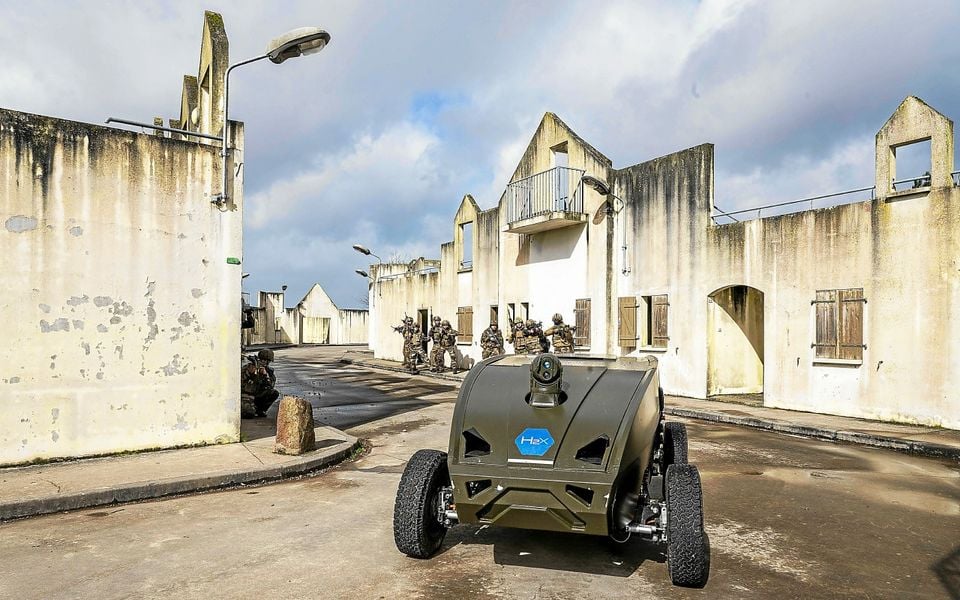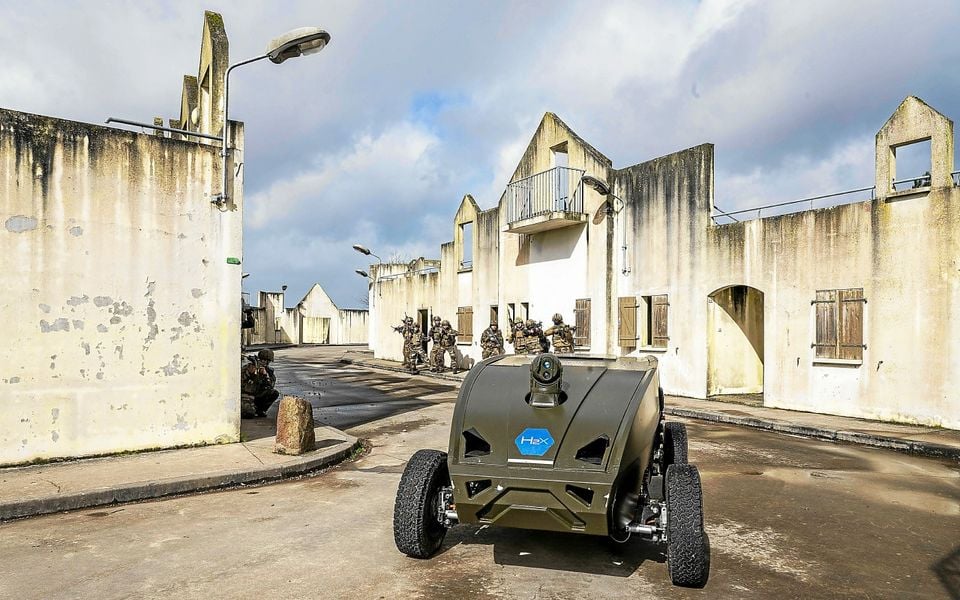
At MSPO 2025 in Kielce, Polish integrator P.H.U. Lechmar and French hydrogen specialist H2X-Defense unveiled Hermione, a modular, wheeled unmanned ground vehicle that pairs hydrogen fuel-cell propulsion with electric hub motors and a substantial battery pack. The demonstrator was shown in a drone-carrier configuration and pitched as a response to a growing demand for long-endurance, low-signature robotic platforms that can shoulder logistics, sustain forward sensors, and perform reconnaissance or armed support tasks.
Hermione’s mechanical and energy architecture is straightforward by design. The demonstrator measures about 3.3 metres long, 1.85 metres wide and 1.4 metres tall, with a ground clearance of 300 millimetres and a curb weight near 700 kilograms in the MSPO configuration. The version displayed carried roughly 300 kilograms of payload; the partners describe heavier configurations rated at 600 kilograms and up to two tonnes for future mission sets. Mobility comes from all-wheel drive and in-wheel electric motors rated at about 8 kilowatts each. Energy is supplied by hydrogen fuel cells fed from TPED-certified cylinders, backed by a 25 kWh battery that the companies say supports operations of up to 20 hours in the demonstrator; hydrogen refuelling or cylinder replacement is reported to take only a few minutes. Those performance claims, if realised in serviceable hardware, would place Hermione’s endurance and re-supply model in a different class to battery-only vehicles.
Hydrogen as a power source offers a compact energy density advantage compared with current battery chemistry; it also supports quiet electric drive and exportable power for sensors or recharging other systems. H2X-Defense accompanied the UGV with a hydrogen field generator, the G-15/050, rated in multiple configurations and able to store or deliver power to mobile systems. That pairing illustrates a concept of operations where a small hydrogen logistics train can sustain distributed unmanned assets and reduce the need for fossil fuel convoys in forward areas. Practical challenges remain; hydrogen handling, TPED certification, transport safety, and field refuelling under combat conditions all require carefully controlled procedures and equipment.
Conceptually, Hermione aligns with a broader shift in unmanned ground systems from short-range, battery-limited demonstrators toward hybrid and alternative-fuel platforms that prioritise endurance and exportable power for forward units. Comparable systems in the market show different tradeoffs. Tracked hybrid platforms such as Milrem Robotics’ THeMIS offer modular payloads and have been adapted for logistics and combat support; Rheinmetall’s Mission Master family exploits hybrid diesel-electric architectures to deliver long range and heavy payloads. Those examples illustrate that militaries want UGVs that integrate readily with existing logistics chains and command systems while offering modularity across mission sets. Hermione’s hydrogen approach is an attempt to capture endurance benefits without the logistical weight and thermal signature of diesel.
The operational utility of a hydrogen UGV is a matter of system integration and logistics as much as it is of propulsion. Hermione’s strengths on paper are endurance, low acoustic and thermal signature during silent operation, and the ability to act as a mobile power node for sensors, small drones, or expeditionary command posts. In practical terms, units will evaluate how easily cylinders can be swapped under fire, how well the vehicle tolerates dust and temperature extremes, and how resilient its electric propulsion and fuel-cell stack are to battle damage and electromagnetic interference. Stores of hydrogen and refuelling equipment introduce a different vulnerability profile compared with fuel convoys; mitigating that profile means hardened supply containers, disciplined handling procedures, and robust distribution planning.
Modularity is central to Hermione’s mission logic. The demonstrator used a UAV carrier configuration, but the chassis is described as a common base for logistics, reconnaissance, electronic payloads, or remote weapon stations. This approach mirrors the prevailing design pattern in UGV development; platforms that can accept mission modules reduce fleet complexity and allow commanders to tailor robotic assets to discrete tasks. The designers will need to prove that mission swaps can be done quickly in the field and that control and autonomy software can manage different payloads without adding operator cognitive load. Interoperability with existing tactical radios, mission management systems, and C2 frameworks will be a decisive factor in adoption.
Autonomy and command will matter too. Current operational uses of UGVs range from supervised teleoperation to high-level autonomy for waypoint navigation and convoy functions. Hermione’s introduction at MSPO did not disclose the full autonomy stack; integration with standard control suites and remote operator stations will determine whether the vehicle operates as a simple remote tool or as a semi-autonomous teammate. Milrem and Rheinmetall offer examples where autonomy reduces operator burden and allows a single controller to manage several vehicles; similar capabilities would be expected for Hermione to scale in tactical units.
From an industrial and procurement perspective, Hermione demonstrates how cross-border collaborations can fast-track novel powertrain concepts into demonstrators. P.H.U. Lechmar’s role as a systems integrator and H2X-Defense’s hydrogen expertise reflect a supply-chain model in which small, specialised firms deliver niche capabilities that larger primes can later absorb or partner to scale. For defence planners the question is whether hydrogen logistics can be fielded affordably and safely at unit level; recent naval and expeditionary experiments with hydrogen generators and fuel cells show interest across services in exportable, low-signature power, but they also emphasise matured doctrine and handling procedures as prerequisites for adoption.
There are, finally, regulatory and safety angles to consider. TPED certification for cylinders is a necessary step for transport and storage; compliance with national and NATO standards will be required before large-scale deployments. Training for ordnance and logistics personnel must include hydrogen handling and emergency response. Equally, sustainment models must account for fuel production or forward refuelling assets; a hydrogen UGV fleet without a viable refuelling plan is a limited fleet. H2X-Defense’s field generator and containerised fuel solutions point toward possible approaches, yet field trials and exercises are the only reliable test of whether those approaches scale in contested operations.
Hermione is an instructive data point in the fast-evolving UGV landscape. It is not the only path forward, but it shows how alternative fuels can be married to modular robotics to offer a different balance between endurance, signature management and logistical footprint. The next steps are clear: rigorous field trials, interoperability testing with command systems, durability assessment across climates, and realistic logistics experiments that stress hydrogen re-supply under operational conditions. If those trials validate the demonstrator’s claims, hydrogen-powered UGVs could become a practical option for missions where endurance and low signature matter more than raw payload. For now, Hermione is a prototype with an intriguing promise; military customers and integrators will watch how the design performs when the first units are pushed beyond the exhibition hall and into demanding exercises.