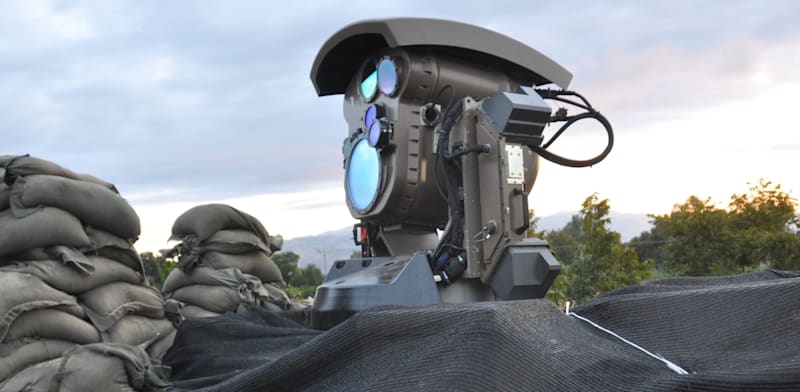
Rafael Advanced Defense Systems used DSEI 2025 in London to unveil the IRON BEAM 450, a new high-energy laser intended to add a directed-energy layer to conventional air and missile defence. The company positions the system as a precision interceptor for rockets, artillery, cruise missiles, and swarming unmanned aerial systems; Rafael says the weapon delivers near-zero per-intercept cost and rapid retargeting, qualities that make lasers attractive as a persistent, low-logistic solution for defending bases and littoral forces. Public briefings and trade-show coverage make clear that Rafael expects the IRON BEAM 450 to sit inside multi-layered architectures alongside kinetic interceptors and active protection systems.
How the system is designed to work is straightforward in concept and demanding in execution. A high-energy laser produces a coherent beam that is steered onto a critical point of an incoming object until structural failure, ignition, or sensor disruption occurs; because the “ammunition” is electrical energy, the system effectively has an unlimited magazine so long as it has power and cooling. Rafael describes IRON BEAM 450 as using multifunction beam directors together with coherent beam combination and adaptive optics; those elements are intended to extend effective range, stabilise the beam on a moving target, and compensate for atmospheric turbulence. In practice, directed-energy interception is constrained by line-of-sight, atmospheric conditions such as fog or heavy rain, and the available platform power; trade-offs between beam power, dwell time, and engagement geometry determine which threats can be defeated and at what ranges.
The military logic for adding lasers is economic and tactical. Traditional interceptors impose a recurring logistics and cost burden; a single surface-to-air missile can cost tens or hundreds of thousands of dollars, while a directed-energy shot is measured in the cost of electricity and wear on hardware. That arithmetic has driven naval and land experiments since the 2010s, including the U.S. Navy’s Laser Weapon System trial aboard USS Ponce and more recent Army-directed-energy efforts to integrate 50 kW-class lasers on Stryker vehicles for short-range air defence. These programmes have demonstrated that lasers can defeat small, asymmetric threats such as unmanned aircraft and small boats while reducing magazine constraints in high-rate swarm events. The IRON BEAM 450 follows that trajectory, aiming to add higher power and improved beam control to broaden the envelope of defeatable threats.
Operational employment will require clear doctrine and careful systems integration. A deployed IRON BEAM battery must be fed by robust power generation and cooling; naval installations can leverage a ship’s power plant while land sites need generators, batteries, or hybrid power nodes to sustain protracted engagements. Rafael’s public materials and DSEI displays also emphasise remote operation and data-linked integration so the laser can be controlled within a multi-sensor fire-control chain; that placement allows commanders to place the laser where it best complements missile interceptors and kinetic short-range systems such as active protection systems. Real-world employment will have to reconcile the laser’s fast engagement and low marginal cost with constraints on weather, obscurants, and the need to coordinate across civilian airspace when defending population centres.
Directed-energy systems are not a single-solution replacement for existing defences; rather, they are best understood as a new layer in a complex protection architecture. For example, missile-defeat suites combine long-range interceptors, mid-tier systems, short-range guns and missiles, and, increasingly, directed-energy weapons. Israel’s national air-defence posture has long used layered systems to balance cost, range, and throughput; Rafael’s own family of systems, which the company says includes naval and land variants, is presented as complementary to kinetic shields and to Rafael’s existing active-protection and counter-drone portfolio. Past operational trials and recent reports indicate that laser systems can provide rapid engagement against small, low-cost threats while reserving missiles for high-energy or long-range targets; effective doctrine therefore leverages the strengths of both physics and munitions economics.
Technical hurdles remain and will define how quickly IRON BEAM-class systems move from prototype to routine deployment. Atmospheric effects scatter and absorb laser energy; adaptive optics and beam combining mitigate that to an extent, but performance still drops in heavy precipitation and dust. Power generation and thermal management form another engineering choke point; continuous high-energy operation requires cooling loops and power provisioning that are complex to field. Finally, integration into existing sensor and command systems is a non-trivial software and communications task; automated cueing from radars, electro-optical trackers, and battle management systems must be tightly synchronised to avoid fratricide or wasted dwell time. These are engineering and doctrine problems rather than conceptual ones; prior naval and land experiments provide a roadmap but not a turnkey answer.
Rafael’s public messaging around IRON BEAM 450 also plays to political and operational narratives. Laser interceptors produce little collateral debris and can be calibrated to disable sensors rather than destroy entire ordnance bodies, which matters when protecting urban areas. Rafael has framed the system as a low-cost, precise option for protecting sensitive facilities, ports, and littoral assets. Industry observers note that the firm’s claims will be tested in live-fire trials and by how the system is integrated with national command and control; real operational credibility follows from demonstrable performance in adverse conditions and from sustained logistics and training plans, not from trade-show announcements alone.
The unveiling at DSEI is part of a broader global push toward directed-energy arms; the United States, Europe and Israel have all invested in fielding lasers for close-in defence and counter-unmanned-aircraft missions. The U.S. Army’s DE M-SHORAD effort has advanced 50 kW-class systems for mobile short-range air defence, and the U.S. Navy continues to iterate shipboard laser designs after initial experiments with LaWS a decade ago. Those programmes provide useful comparators for Rafael’s work: they show how fielding timelines are driven as much by power and cooling logistics as by raw beam physics. For defence planners, the choice will be about mixing mission sets and basing models to exploit lasers where they are most efficient, while retaining missiles where speed, range, and all-weather performance are mandatory.
What the IRON BEAM 450 means for armed forces is therefore pragmatic rather than revolutionary. If the system meets its stated goals for engagement speed, retargeting and per-shot economy, it will become a cost-effective layer for countering rockets, mortars, drones and short-range cruise threats. If it struggles under adverse conditions or proves difficult to integrate with existing power and command structures, its role will be narrower and more specialised. Either way, Rafael’s new laser joins a small but expanding class of fieldable directed-energy weapons that are reshaping calculations about layered defence, logistic footprint and the economics of intercept. The coming months of trials, integration exercises and doctrine development will determine how quickly the technology becomes a routine part of air-defence toolkits.
In the immediate term Rafael will seek to show the IRON BEAM 450’s capabilities through demonstrations, vendor trials and partner engagements; procurement cycles and national decisions will then weigh demonstrated performance against cost, basing constraints and interoperability with allied systems. For military readers, the salient questions are clear: how does the weapon perform in poor weather; how much sustained power and cooling does it require at the point of use; and how will commanders fuse laser cueing into air-defence decision chains without increasing latency or cognitive load. Those answers will determine whether IRON BEAM 450 becomes a common sight at defended bases and ships, or whether it remains a specialised tool for particular missions.