In an era where low-cost commercial drones and coordinated unmanned swarms dominate modern battlefields, traditional air defense systems are facing an economic and logistical breaking point. Firing a million-dollar missile to intercept a $2,000 drone is simply unsustainable.
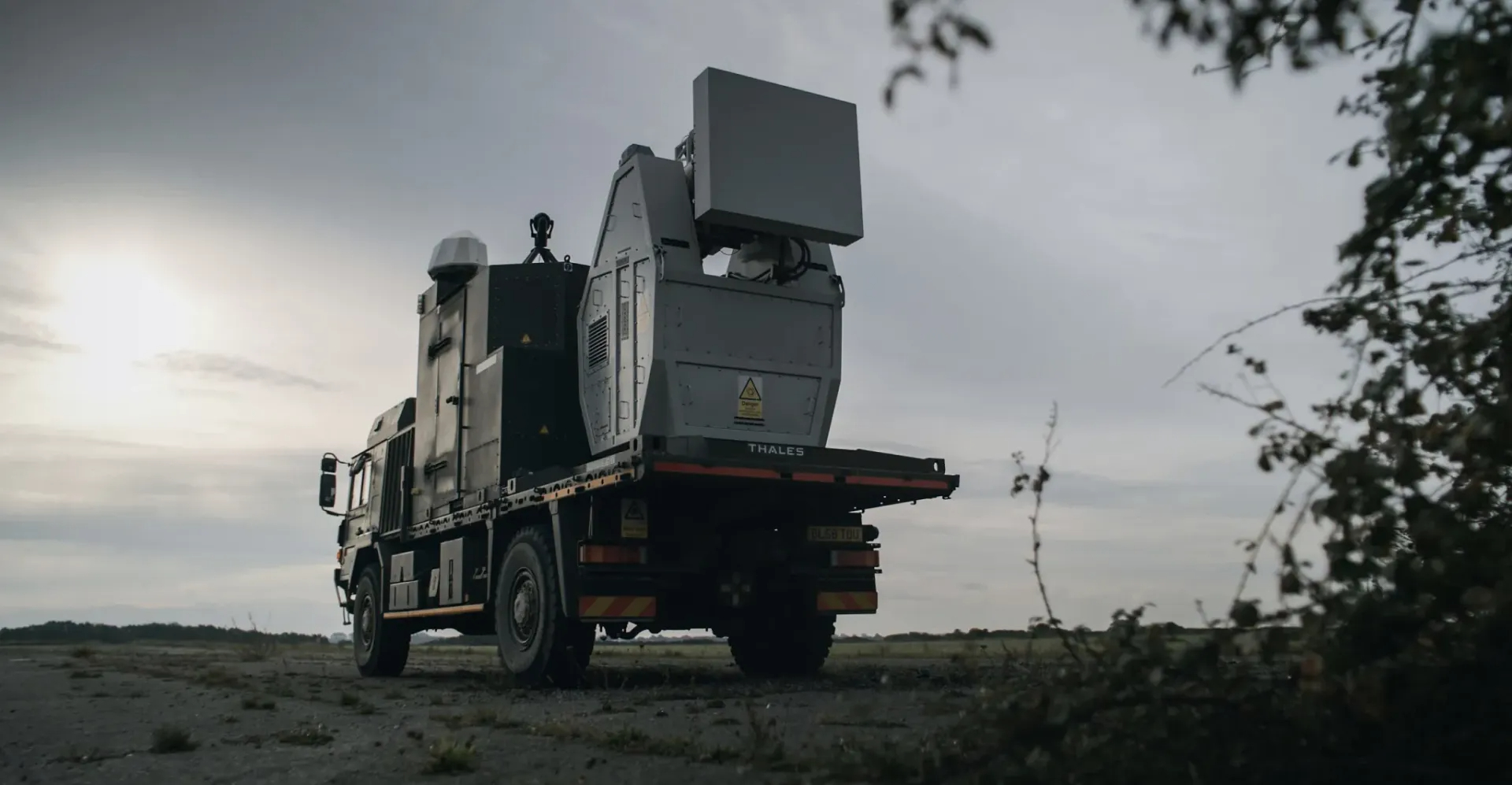
Stepping into this tactical void is RapidDestroyer, a cutting-edge Radio Frequency (RF) Directed Energy Weapon (DEW) developed by Thales UK. In a recent round of trials, the system demonstrated its battlefield readiness by successfully neutralizing 80 drones in individual engagement scenarios, signaling a massive leap forward in counter-drone technology.

The April 2026 Trials: Precision at Scale
The landmark trials took place in April 2026 at Pershore, Gloucestershire, conducted in close partnership with England-based tech firm Teledyne e2v.
The primary objective of this testing phase was to evaluate a newly upgraded four-panel effector configuration. This engineering enhancement is designed to maximize energy delivery by concentrating vastly higher amounts of RF energy onto a single target, while also extending the operational range to allow the system to engage hostile drones much further out than legacy systems.
Because of the high volume of testing, Thales engineers were able to conduct forensic analysis on all 80 engagements. The data revealed a striking trend: the weapon achieved consistent, near-immediate defeats, instantly dropping the drones and permanently preventing them from recovering or re-engaging.
How it Works: Hard-Kill RF vs. Lasers and Jammers
To understand the breakthrough of RapidDestroyer, it is important to distinguish it from other electronic warfare and directed energy technologies.
Unlike conventional jamming, which is a “soft-kill” method that merely tries to disrupt control links or GPS signals, RapidDestroyer is a “hard-kill” system. However, it also differs fundamentally from laser-based directed energy weapons. While lasers rely on concentrated light and intense heat to physically melt through a drone’s structural components, RapidDestroyer emits high-intensity RF waves. These waves bypass the exterior and directly target the sensitive electronic systems inside the drone, frying its internal circuitry. It isn’t just interrupting a signal; it is permanently breaking the brain of the aircraft, rendering it completely incapable of resuming its mission or launching further attacks.
British Origins, AI Brain
RapidDestroyer is a proudly UK-developed system, fully integrated with Thales’ proprietary command-and-control and weapon control software.
At the core of its rapid response capability is an Artificial Intelligence (AI) brain. The AI assists the system by autonomously detecting, tracking, and responding to threats with maximum efficiency. This allows the weapon to handle dense, fast-moving swarm attacks that would easily overwhelm human reaction times. Crucially, while the AI manages the heavy computational lifting and threat response optimization, Thales emphasizes that the system operates with a “human-in-the-loop” architecture, ensuring a human operator always maintains final monitoring and engagement approval.
Solving the Cost-Curve Problem
For modern armed forces, the appeal of RF directed energy weapons like RapidDestroyer boils down to economics and magazine depth. As one-way attack drones and coordinated swarms become a staple of global conflict, military forces need an answer that doesn’t run out of ammunition. The ability to engage multiple threats back-to-back—without rapidly exhausting expensive missile stocks—completely rewrites the rules of air defense. With its recent successful trials, Thales’ RapidDestroyer has proven it is ready to turn the tide against the drone swarm threat.