

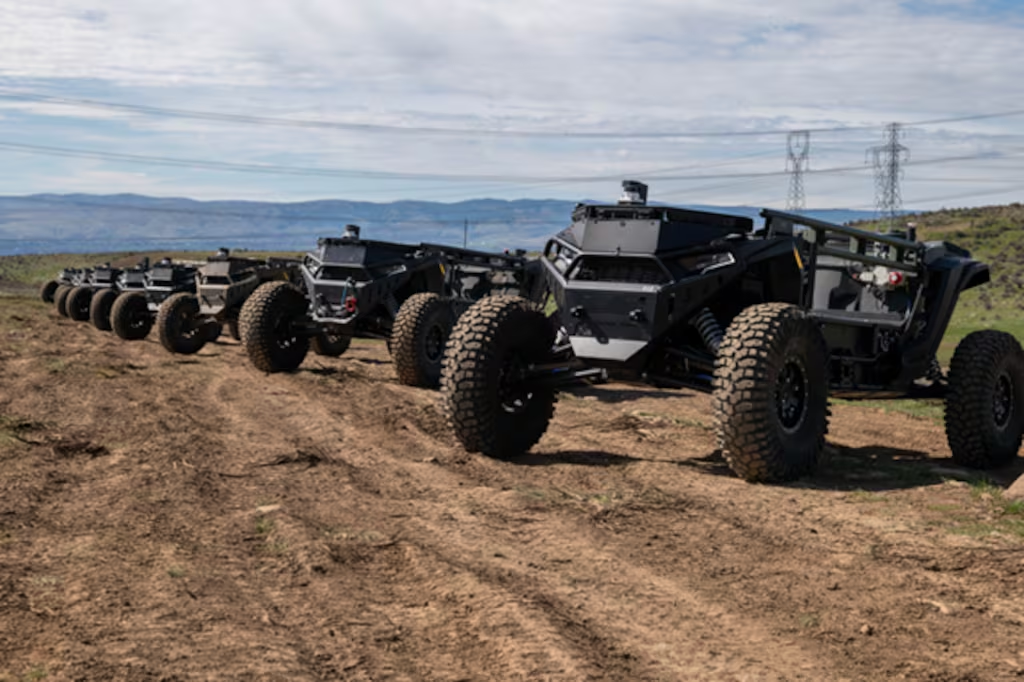
The U.S. Marine Corps has taken a step that the broader American military has been slowly building toward for years: it has awarded a production contract — not a prototype agreement, not a demonstration programme, but an actual production contract — for fully autonomous ground vehicles. The $19.7 million deal, awarded to Seattle-based Overland AI on June 27, 2026, makes the company the first ground autonomy firm to hold a production prime contract with the U.S. military. And the mission the vehicles are being built for says a great deal about where autonomous ground systems are headed next.
The Contract and What It Covers
The award came through the Pentagon’s Accelerate the Procurement and Fielding of Innovative Technologies (APFIT) programme, administered by the Office of the Under Secretary of War for Research and Engineering. APFIT is a fast-track funding mechanism designed to accelerate the transition of mature technologies from the experimental phase into production, compressing a procurement cycle that conventionally takes years into a timeline measured in months. That mechanism matters here, because speed is precisely the point.
The contracting mechanism is an Other Transaction Authority (OTA) production agreement. OTA is a legal authority that allows the Department of Defence to bypass some of the more cumbersome requirements of the standard Federal Acquisition Regulation when acquiring innovative technologies, particularly from companies — like Overland AI — that are not traditional defence contractors and whose primary development work has happened outside the conventional military procurement pipeline. It is the same class of acquisition tool used to rapidly field other emerging technology programmes, and its use here signals that the Marine Corps is treating ground autonomy as an urgent operational need rather than a long-term research investment.
The $19.7 million package covers not just the hardware but the complete autonomous system. According to the Pentagon announcement confirmed by DefenseScoop, the contract includes Overland AI’s OverDrive autonomy software stack, its OverWatch command-and-control interface, vehicle spares, and associated services. The distinction matters. Overland AI is not integrating its software onto a vehicle built by a different prime contractor — it is delivering the entire system, hardware and software together, under its own prime contract. Boots drew that distinction explicitly: “We’re not integrating software onto another prime’s vehicle — we’re priming the contract, and we’re delivering the entire system.”
For comparison, rival ground autonomy firm Forterra won a larger $92 million Marine Corps production deal earlier in June 2026 — but as the autonomy supplier under prime contractor Oshkosh Defense, not as the contract prime itself. The organisational distinction is what Overland AI is staking its claim to as a first.
What Makes These Vehicles Autonomous — and Why That Matters
The source text makes a point of distinguishing between uncrewed ground vehicles and autonomous ground vehicles, and it is a distinction worth dwelling on, because it goes to the heart of what makes this contract genuinely novel.
Uncrewed vehicles have existed in military use for years. What most of them have in common is that they are tele-operated — a human operator somewhere, with a radio link and a screen, drives the vehicle from a distance. The vehicle itself has no independent decision-making capability. If the radio link is jammed or dropped, the vehicle stops. One operator can typically manage one vehicle at a time. The human-to-machine ratio is effectively 1:1, or close to it.
Overland AI’s vehicles are different. They carry onboard sensors, computing hardware, and the OverDrive autonomy stack — a software system that perceives and maps terrain using active and passive sensors, identifies traversable paths, avoids obstacles, and navigates toward its objective without requiring continuous human input and, critically, without relying on GPS or pre-mapped routes. Boots drew the distinction for reporters at the June 29 media roundtable: “Autonomous ground vehicles are uncrewed, but they also have software and sensors and compute on board, which allows them to autonomously move through terrain and on the battlefield. They’re less susceptible to contested communications; they can continue to operate even if they lose connectivity. And it allows for scaling — a single operator can task multiple vehicles if each of those vehicles has autonomous capabilities.” (DefenseScoop, June 29, 2026.)
That last point — scaling — is the one that matters most operationally. A 1:1 human-to-vehicle ratio for tele-operated systems means that every vehicle you want to field requires a dedicated operator. In a Marine Corps unit that is already managing sensors, weapons systems, communications, and air defence tracking simultaneously, adding a tele-operated resupply vehicle just adds another operator requirement to an already stretched crew. An autonomous vehicle that can be tasked, monitored, and re-tasked by a single operator managing a fleet fundamentally changes that equation. The OverWatch command-and-control interface is the tool that enables that fleet management — allowing one operator to coordinate multiple autonomous ground systems, plan optimised routes, re-task vehicles in response to threats, and deploy payloads, all from a single interface.
Both OverDrive and OverWatch are included in the MADIS contract package.
MADIS: The Air Defence System These Robots Will Support
The Marine Air Defense Integrated System (MADIS) is the operational context that gives this contract its strategic specificity. MADIS is the Marine Corps’ fielded mobile short-range air defence system, mounted on the Joint Light Tactical Vehicle (JLTV). It combines sensors and weapons on a manoeuvrable wheeled platform to detect, track, and defeat adversary drones and low-flying manned aircraft — the kind of threats that have come to define the modern battlefield following Ukraine, Gaza, and the Red Sea campaign.
The system is already fielded and operational. The 26th Marine Expeditionary Unit, for example, has operated MADIS-equipped JLTVs during exercises including simulated drone intercepts aboard amphibious assault ships. But a mobile air defence system that has to stay close to its parent vehicle for resupply is still constrained by the logistics of the convoy. If the MADIS battery runs low on interceptor rounds, the crew either risks exposure by returning to a supply point or waits for a resupply vehicle — driven by a Marine — to come forward to their position under potentially hostile conditions.
An autonomous ground vehicle changes that dynamic. It can carry ammunition, spare components, fuel, or other consumables from a protected position to the forward MADIS element without requiring a crew to make the trip. It removes the human from the most exposed part of the logistics chain. Boots made the operational logic plain: “The uncrewed ground vehicle removes an operator from the proximity of whatever you’re doing, and you can imagine how useful that will be.”
Joe Klocek, Programme Manager for Ground Based Air Defence at the U.S. Marine Corps, confirmed the intent in Overland AI’s official press release: “We look forward to incorporating the Overland AI capability into the Marine Corps’ Ground Based Air Defense portfolio. Pairing the autonomous platforms with our Marine Air Defense Integrated System will greatly extend the operational reach and lethality of our air defence units.”
Boots was careful to frame the vehicle’s initial role as additive rather than replacement. “It’s not intended to replace the JLTV. We’re going to start by integrating the vehicle into the system, providing a resupply capability for the other vehicles which are part of the system, and we may build on it from there.” That sequencing is deliberate — starting with the less operationally contentious mission of autonomous logistics before moving to applications closer to the direct engagement zone.
The Platform: ULTRA and What’s Coming Next
Overland AI’s primary publicly known vehicle is the ULTRA, a fully autonomous tactical Unmanned Ground Vehicle (UGV) that weighs approximately 2,500 pounds (around 1,100 kg) and carries a payload of about 1,000 pounds (roughly 450 kg). Its multi-payload capacity is designed to accommodate a range of mission-specific equipment — resupply loads, sensor packages, or other hardware depending on the assignment.
Boots declined to confirm whether ULTRA is specifically the vehicle being delivered under the MADIS contract, describing the vehicle as a “light ground vehicle with multi-payload capacity” that Overland has designed and built in-house. That deliberate ambiguity, combined with a hint that there could be a new member of the Overland AGV family in the works, suggests the company may be preparing a next-generation or mission-specific variant for the Marine Corps programme. More details, Boots said, would be made available closer to delivery.
What is confirmed: the Marine Corps will receive more than a dozen autonomous ground vehicles under the contract, with initial deliveries expected to begin approximately nine months after award — placing first deliveries in early 2027. The vehicles are not designed for any single theatre of operations, Boots said, and can traverse “a very wide range of different terrain,” making them adaptable to environments from the Pacific islands that feature heavily in Marine Corps planning to European or Middle Eastern terrain.
Overland AI’s Proven Track Record in Military Operations
This contract did not emerge from a cold-start relationship between Overland AI and the U.S. military. The company was founded in 2022 by a team of robotics researchers from the University of Washington, spun out of DARPA’s vehicle autonomy programme — which has historically served as the origin point for some of the most consequential ground autonomy technology in the American defence ecosystem.
Since then, Overland AI’s autonomy stack has been integrated into several platforms already operating across the U.S. military. Its technology powers vehicles including General Dynamics’ Small Multipurpose Equipment Transport (S-MET) — the Army’s primary autonomous logistics vehicle for infantry formations — as well as ground vehicles operated by the Army’s 18th Airborne Corps and Textron’s Ripsaw M5, an unmanned combat vehicle designed for high-intensity operations. DARPA itself has used the company’s system as part of its research portfolio.
On the exercise and operational testing front, Overland AI provided the 173rd Airborne Brigade with autonomous vehicles for breaching and resupply operations during Exercise Agile Spirit and Exercise African Lion — the latter being U.S. Africa Command’s largest annual exercise, held in Morocco in May 2026. The company also supported the 82nd Airborne Division with autonomous ground vehicles for Intelligence, Surveillance, and Reconnaissance (ISR) missions during a six-month period centred on a training rotation at Fort Polk, Louisiana.
That operational track record is part of what makes the MADIS contract plausible on a nine-month delivery timeline. Overland AI is not starting the engineering work from scratch; it is adapting and scaling a system that has already demonstrated its autonomy stack in real field conditions with operational units.
From Experiment to Production: The Shift That Defines This Moment
Boots’ most pointed comment at the June 29 roundtable was not about the ULTRA vehicle or the MADIS integration or the nine-month delivery timeline. It was about what this moment represents for the wider field of ground autonomy.
“The thing that we’re really excited about here is the fact that we are at a point where the U.S. military is really seeing the utility of vehicles like this and has moved beyond experimentation and prototyping to production contracts,” he said. “We’re excited to lead the way there.”
That transition — from experiment to production contract — is the meaningful threshold this award crosses. The U.S. military has been experimenting with autonomous ground vehicles for well over a decade. DARPA’s Urban Challenge in 2007 is frequently cited as the catalytic moment for modern ground autonomy research. Since then, the Army, Marine Corps, and Special Operations Command have run dozens of exercises, demonstrations, and pilot programmes that put autonomous ground platforms in the hands of operational units. Those programmes generated enormous amounts of operational data and doctrine development. What they have not typically resulted in is a production contract where a ground autonomy company holds the prime and delivers systems that go into a fielded programme of record.
As we covered in our recent analysis of USSOCOM’s AI and autonomy investment strategy, U.S. military units across multiple services have been “leaning forward into autonomy” at a pace driven directly by what they have observed in Ukraine and the Middle East. Uncrewed ground vehicles have proliferated across the Ukrainian battlefield for logistics, ISR, mine clearance, and — increasingly — direct combat applications. The lessons have not been lost on Marine Corps and Army planners who are trying to build the same operational logic into their own force structure before a peer adversary conflict tests it for real.
The difference between a prototype exercise and a production contract is that someone is now building these vehicles to go to operational units, not to be evaluated and returned. The Marine Corps is committing to integrating autonomous ground systems into a live programme of record, which means doctrine, training, maintenance, and follow-on procurement all follow from this decision. That is the institutional permanence that separates a research investment from a capability.
What Comes Next: Beyond Resupply
The MADIS resupply mission is the starting point, but it is clearly not the ceiling. The contract language and Boots’ public comments both suggest a deliberate strategy of beginning with the operationally conservative application — autonomous logistics — and building from there toward more demanding missions as the Marine Corps develops confidence in the system’s reliability in the field.
The integration pathways are already visible. MADIS is itself a counter-drone system, and an autonomous vehicle supporting it could eventually carry more than resupply loads — it could carry additional interceptor rounds to reload a JLTV-mounted launcher, serve as a forward sensor node extending the system’s detection range, or even carry its own counter-drone payload. Boots acknowledged the possibility: “We may build on it from there.”
The ISR application that Overland AI demonstrated with the 82nd Airborne is another obvious next step — autonomous vehicles pushing forward to gather reconnaissance data without exposing human crews, feeding that data into the kind of AI-enabled common operating picture that the Army is building through its Mission Command System and the Project Convergence programme.
And the mine clearance application — demonstrated in Project Convergence Capstone 5 — points toward a direct combat engineering role for autonomous ground vehicles that removes soldiers from the most hazardous phase of a breach operation entirely.
For the Marine Corps specifically, the Pacific focus of its force planning raises the question of how autonomous ground vehicles function in island-hopping, expeditionary operations where logistics are particularly challenging and the exposure of personnel during resupply is particularly dangerous. An autonomous vehicle that can carry supplies from a protected ship-to-shore transfer point to a forward MADIS battery position on a contested island, without requiring a Marine to drive it, directly addresses one of the most operationally dangerous tasks in that scenario.
Ground autonomy has been a research priority for the U.S. military for fifteen years. What June 2026 marks is the moment that priority became a production programme.
The Overland AI contract is modest in dollar terms — $19.7 million and more than a dozen vehicles is not a large-scale fielding. But it is the first time a ground autonomy company has held the prime on a production contract, the first time autonomous ground vehicles are being delivered to a Marine Corps programme of record, and the first time the MADIS air defence architecture is being extended with autonomous logistics support. All of those firsts carry weight not because of what they deliver today, but because of the institutional doors they open for what comes next.
As we have covered extensively across our autonomous systems reporting, the transition from experimentation to scaled operational employment is the hardest step in any emerging technology’s military adoption path. Overland AI just crossed it for ground autonomy — and the Marine Corps’ willingness to make that transition official, in a production contract, with a delivery timeline measured in months rather than years, is the clearest signal yet that autonomous ground vehicles are no longer the future of military operations.
They are the present.
