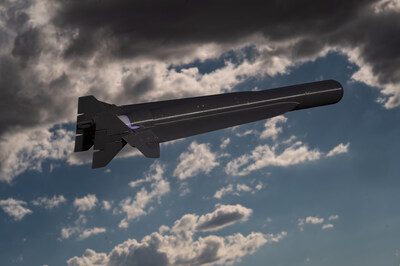
Cummings Aerospace has successfully validated the extended range capabilities of its Hellhound S3 loitering munition, marking a pivotal step in the development of man-portable, jet-powered unmanned aerial systems (UAS). During a flight test conducted on September 18, 2025, at the Pendleton UAS Range in Oregon, the system demonstrated endurance metrics that suggest a maximum operational range exceeding 60 kilometers.
The test event focused on verifying the platform’s aerodynamic efficiency and fuel consumption profiles. Launching vertically from a canister, the Hellhound S3 transitioned to horizontal flight and executed a series of tight figure-eight loiter patterns over a designated target zone. Carrying an inert warhead to simulate operational weight, the aircraft flew more than 30 kilometers before engineers concluded the data collection phase. Telemetry indicated that the vehicle landed with over 50 percent of its fuel remaining.
These results are particularly notable for a Group 1 UAS. The Department of Defense (DoD) defines Group 1 assets as those weighing less than 20 pounds and operating below 1,200 feet. Typically, drones in this class are battery-powered quadcopters or small fixed-wing airframes with limited range and speed. The Hellhound S3 breaks this mold by utilizing a micro-turbojet engine, allowing it to cruise at 80 meters per second (approximately 180 mph) and achieve top speeds of 384 mph. This kinematic performance enables the system to intercept faster Group 2 and Group 3 threats, such as the Shahed-136 series of one-way attack drones, which propeller-driven interceptors often struggle to catch.
Sheila Cummings, CEO of Cummings Aerospace, noted that the test validates the system’s persistent loitering capability at ranges that extend the reach of infantry units. By pushing the effective radius of a man-portable asset beyond 60 kilometers, the system provides small tactical units with a strike and reconnaissance capability previously reserved for higher-echelon assets.
Rapid Manufacturing and Modular Design
The Hellhound program relies heavily on additive manufacturing (3D printing) and a Modular Open Systems Architecture (MOSA). This industrial approach allows Cummings Aerospace to rapidly iterate designs based on flight data and direct feedback from soldiers. The use of 3D printing for the airframe, combined with DoD-approved commercial off-the-shelf components, aims to lower the cost per unit and simplify logistics. This strategy aligns with the Pentagon’s broader push for “attritable” mass—systems cheap enough to be deployed in large numbers without fiscal strain.
The system’s modularity extends to its payload bay. Soldiers can swap mission modules—ranging from kinetic warheads to Electronic Warfare (EW) and Intelligence, Surveillance, and Reconnaissance (ISR) packages—in under two minutes without using tools. This flexibility allows a single airframe to switch roles from a kinetic interceptor to a sensor platform depending on the immediate tactical requirement.
Strategic Context and Future Variants
The successful validation of the S3 variant supports the company’s expansion into larger systems. Cummings Aerospace is currently developing the Hellhound S4, a larger Group 2 UAS. This variant is designed to be tube-launched and vehicle-mounted, offering increased payload capacity and endurance.
Industry observers note that the S4 is being positioned to support the “Golden Dome” initiative, a proposed multi-layered missile defense architecture intended to protect the United States homeland. Within this architecture, the S4 could fulfill a gap-filling ISR role, providing granular low-altitude coverage that complements larger, more expensive radar systems. The S4’s removable nose cone allows for the integration of specialized sensor suites tailored to this homeland defense mission.
Upcoming Milestones
Following the successful range validation, Cummings Aerospace has outlined a series of technical objectives for the coming months. The engineering team will focus on flight testing automatic target recognition algorithms, a critical component for enabling the system to operate effectively in commercially congested or GNSS-denied environments.
Additionally, the company plans to develop and demonstrate “hunter-killer” concepts of operations (CONOPS), where Hellhound units work in concert to locate and engage targets autonomously. These demonstrations will be conducted for U.S. Army and other defense customers to verify the system’s utility across diverse mission sets.
Having achieved Technology Readiness Level 7 (TRL-7) and Manufacturing Readiness Level 7 (MRL-7), the Hellhound S3 has demonstrated reliable performance in operationally realistic conditions and is nearing full-rate production capability. As the U.S. military continues to prioritize the acquisition of cost-effective, adaptable unmanned systems, the Hellhound’s combination of jet speed and 3D-printed scalability positions it as a distinct competitor in the crowded loitering munition market.