


The phrase US China AI weapons race captures a rapidly evolving technological contest that is already influencing procurement budgets, battlefield tactics, and broader security policy. At its core the competition pits U.S. defence innovation ecosystems and private sector leadership against China’s state-driven industrial mobilisation and military modernization. Both sides invest in sensing, autonomy, machine learning, and systems integration to produce weapons that can perceive, decide, and act with varying degrees of human control. That dynamic is changing how militaries conceive of speed, scale, and risk in warfare; it is also altering the kinds of systems that decision makers prioritize for procurement and doctrine.
We look at the technical drivers, real-world examples, policy shifts, and technological bottlenecks that define the US China AI weapons race. It explains how specific autonomous systems perform on today’s battlefields; it integrates the latest public reporting on deployment trends in conflicts such as Libya and Ukraine; and it compares official strategies in Washington and Beijing. Wherever the analysis draws on recent reporting or academic findings, I provide sources so readers can follow the evidence directly. Key claims about battlefield use and national programs are grounded in public reporting and expert research.
Why the US China AI weapons race matters now
Several converging trends explain the acceleration of the US China AI weapons race. First, advances in compute and sensing have lowered the technical barrier to deploy autonomy at scale; affordable sensors, high-performance processors, and robust machine learning models now fit on small platforms such as loitering munitions, uncrewed surface vessels, and reconnaissance drones. Second, recent conflicts provided proof of concept for wide-scale drone swarms, autonomous targeting aids, and unmanned logistics; combatants are consequently pressing suppliers for rapid fielding. Finally, policy choices on both sides have prioritised rapid prototyping and field experiments rather than slow, formal acquisition processes; this creates an environment where incremental software improvements can produce operational advantages quickly.
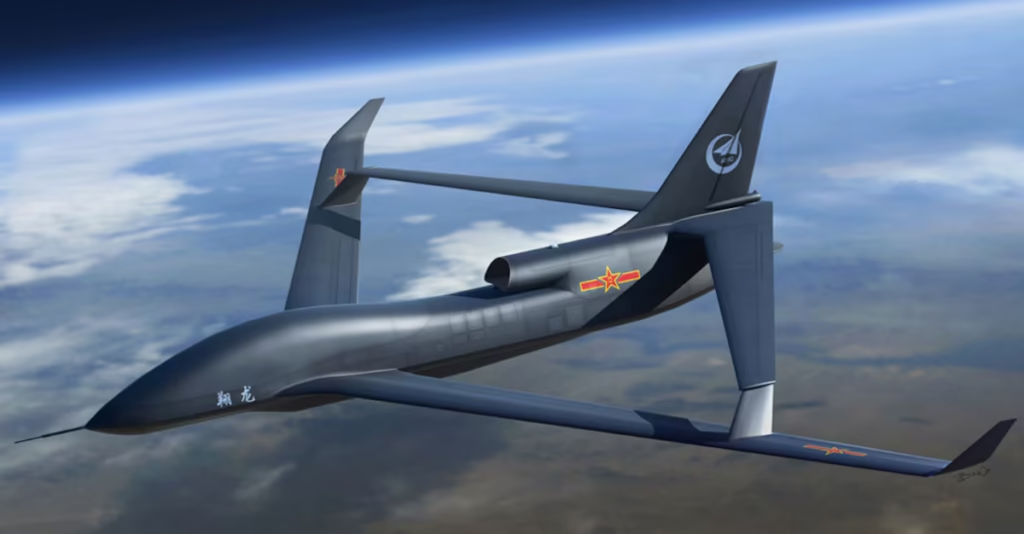
That convergence matters because the practical capabilities of autonomous systems are no longer abstract. Systems that can autonomously search wide areas for high-value targets, assist with sensing and cueing, or sustain operations in contested electromagnetic environments are now plausible and in some cases already in use; this reality compels states to adapt doctrine, industry practices, and export controls. Recent reporting on autonomous and semi-autonomous attacks suggests that the theoretical debate about lethal autonomous weapons has moved into the domain of observable events.
How autonomous weapons differ from remotely piloted systems
The distinction between autonomy and remote piloting is essential for analysing the US China AI weapons race. Remotely piloted systems require human input for critical functions such as target selection and engagement; autonomy delegates some or all of those functions to algorithms. Autonomous weapons vary by level of autonomy; some operate as advanced sensors that offer targeting suggestions to humans, whereas others can search, classify, and engage with minimal or no real-time human oversight. In practice the category spans defensive systems such as automated air defence radars that cue interceptors; offensive loitering munitions that home on targets using onboard vision modules; and hybrid systems that pair supervised autonomy with human approvals in the kill chain.
The U.S. Department of Defense continues to emphasize human involvement at critical stages of engagement in many official frameworks, while also funding autonomy research to speed decisions and handle voluminous sensor data. China’s approach combines civilian AI advances with military engineering to push for platforms that integrate perception, planning, and action in compact packages; this industrial model compresses development cycles by leveraging large domestic AI and manufacturing ecosystems. Both approaches produce operational capabilities that are reshaping expectations about force generation and sustainment.
Are autonomous weapons being used in Libya or Ukraine
Practical experience in recent conflicts provides the clearest evidence that autonomous or semi-autonomous weapons are not merely theoretical. The Kargu-2 quadcopter, produced by a Turkish firm, was cited in a UN panel report on Libya as possibly operating autonomously to attack human targets. Analysts and UN experts reported incidents suggesting the drone operated in a fire-and-forget mode using onboard sensors to identify targets; this episode marked an early, worrying example where autonomy had lethal effects in combat.
The war in Ukraine has accelerated interest in AI-enabled unmanned systems. Ukrainian units and private startups experimented with AI modules that enhance navigation and target recognition under contested communications conditions; multiple reports describe how small teams used AI to keep drones functioning in environments with heavy jamming and latency. Ukrainian developers worked with Western suppliers for sensing and guidance modules that improve strike accuracy and resilience; that work demonstrates how tactical necessity compresses R&D cycles and moves autonomy from lab prototypes into operational use. Reuters and other outlets documented Ukrainian efforts to scale AI-enabled drones for reconnaissance, logistics, and strike missions.
These examples matter for the US China AI weapons race because they reduce the political and technical uncertainty around weaponised autonomy. Where adaptive algorithms and onboard perception can operate in contested environments, the calculus for deployment changes rapidly; states race to close any capability gap that might translate into battlefield losses.
What the United States is doing in military AI
Washington’s response to the accelerating AI weapons field combines large-scale R&D funding, partnerships with commercial AI firms, and policy frameworks intended to manage risk. The U.S. Department of Defense has reorganised acquisition pathways to sponsor faster prototypes and to move AI from isolated pilots into enterprise systems; in recent reporting, the Pentagon signaled plans to “deliver AI at scale,” invoking a push to make AI tools integral to both staff workflows and operational decision making. That shift includes investing in autonomy for sensing, logistics, and command tools.
At the programmatic level Project Maven, robotic swarms trials, and multiple DARPA initiatives illustrate the U.S. emphasis on software iteration, resilient data pipelines, and integration across sensor networks. The private sector also plays a central role; U.S. firms remain leaders in large language models and perception stacks, while defence startups rapidly prototype autonomy for uncrewed systems. Procurement modernization does not mean abandonment of controls; the Pentagon seeks to pair human oversight with automation for high-risk tasks. This strategy influences how the US China AI weapons race unfolds because it blends the commercial pace of Silicon Valley with the institutional depth of Defense labs.
What China is doing in military AI
China pursues autonomy through a combination of centralized planning, industrial policy, and civilian technology integration; the so-called civil-military fusion model accelerates adoption. State directives aim to build advanced AI capabilities by 2030; these plans translate into funding for AI labs, sensor manufacturers, and platform integrators that work closely with the People’s Liberation Army. Chinese defence firms and state research institutes have promoted autonomy in systems ranging from guided loitering munitions to autonomous surface vessels and ground robots. Analysts at Brookings and other institutions note that China’s institutional model enables fast fielding and iterative upgrades at scale.
In addition to government programs, Chinese commercial players lead in sensors such as lidar and in deployment of AI for logistics and industrial automation; that commercial depth gives the PLA access to mature components for weapon systems. Beijing’s competitive posture in the US China AI weapons race relies on synchronising industrial capacity with doctrine that values mass, distributed presence, and survivable networks.
Key technologies shaping autonomy on the battlefield
Several technology threads matter across systems and national approaches. First, sensing and perception; vision, infrared, radar, and lidar feed models that identify objects and scene context. Second, compute and inference hardware; powerful edge processors and accelerators enable onboard models to run without continuous cloud links. Third, machine learning models for detection, tracking, and decision-making; these models must be robust to adversarial conditions such as jamming and spoofing. Fourth, communications and distributed control architectures that coordinate swarms, sensor nets, and human supervisors. Finally, integration engineering, the ability to fuse multiple subsystems and deliver reliable updates in the field differentiates prototypes from deployable systems.
Breakthroughs in any of these pieces change the balance in the US China AI weapons race. For example, progress in small-form accelerators reduces latency and enables more precise onboard image recognition; that in turn increases the autonomy a small drone can exercise in a contested environment. Recent policy debates in the U.S. also focus on how to secure supply chains for critical components such as lidar; lawmakers and defence planners worry about dependency on foreign suppliers for sensors that enable autonomy.
What roles do autonomous weapons perform now in reconnaissance, strike, and logistics
Autonomy is now practical in several operational roles. Reconnaissance: autonomous sensors and loitering platforms can patrol and detect movement across wide areas without constant human control; this saves operator bandwidth. Targeting support: AI can assist with detection, cue human operators, and in some cases perform final attack decisions depending on doctrine. Logistics: uncrewed ground and surface vehicles can ferry supplies where manned convoys are vulnerable; Ukrainian planners publicly discussed scaling robotic logistics to reduce risk to personnel. Defensive systems: automated air and missile defences use algorithms to prioritise tracks and to manage engagement queues under high volume.

These roles show how the US China AI weapons race is not just about offensive strike systems; it involves adapting entire force structures to accept more automated modalities for sensing, sustainment, and protection. Each operational role implies different risk tolerances and control frameworks; militaries will blend autonomy with human judgement in ways that reflect doctrine and operational necessities.
Comparative strengths: US vs China autonomous weapons strengths (where each excels.
The United States holds strengths in advanced semiconductors, foundational AI research, and a vibrant defence start-up ecosystem that partners closely with large tech firms. U.S. firms dominate many aspects of machine learning frameworks and cloud infrastructure that accelerate model training; this creates advantages for rapid algorithmic improvements and access to talent. Meanwhile U.S. defence labs provide systems engineering experience that helps integrate autonomy into complex platforms.
China’s comparative advantage lies in mass manufacturing, large domestic sensor firms, and state coordination that accelerates fielding; China also benefits from a large pool of data for certain AI applications and a willingness to move quickly in dual use arenas. Additionally China often pursues scale to compensate for disparities in individual platforms; swarming concepts and distributed logistics exemplify a strategy that multiplies cheap autonomous nodes rather than focusing solely on single high-end platforms.
Those complementary strengths shape the tactical choices that define the US China AI weapons race; the U.S. may focus on high capability and precision while China may favour high numbers and operational resilience through redundancy.
How reliable are autonomous weapons?
A recurring technical barrier in weaponised autonomy is ensuring reliable performance in messy operational environments. Models trained in lab conditions can fail when confronted by novel weather, contested electromagnetic signals, or adversarial spoofing. Rigorous testing, realistic simulation, and continuous field data collection are necessary to close the gap between prototype and dependable weapon. Both U.S. and Chinese programs invest heavily in testing, though their approaches differ; the U.S. tends to emphasise formal verification and integration at scale, while China often prioritises iterative field experimentation.
Reliability problems translate directly into operational risk; militaries therefore limit autonomy where failure has catastrophic consequences, while employing higher levels of autonomy in lower risk or defensive contexts. The need for robust, interpretable models that admit human oversight is a central engineering challenge for both sides in the US China AI weapons race.
Supply chain risks affect autonomous weapons
Components such as high-end AI accelerators, precision inertial measurement units, and advanced lidars are strategic choke points. Export controls, industrial policy and secure domestic capacity for chips all influence whether a state can field autonomy at scale. Recent legislative initiatives in the U.S. and allied capitals aim to restrict or phase out critical sensor imports from certain countries; that policy dynamic becomes a direct lever in the US China AI weapons race. For militaries, securing trusted suppliers and diversified production lines reduces the risk that a single embargo or supply disruption will halt deployments.
Autonomy spreads beyond great powers
A central concern in the US-China AI weapons race is the rate at which autonomous capabilities diffuse to secondary actors. Cheap drones, open-source perception networks, and accessible computing mean that smaller states and non-state actors can acquire or improvise autonomy. The war in Ukraine showed how relatively affordable kits and software can multiply lethality on the battlefield. As autonomous tools proliferate, the strategic environment grows more complex; controlling diffusion through export policy and norms is part of the competition between Washington and Beijing, even as it raises global stability questions.
Which companies lead autonomous weapons tech in US and China
In the United States, firms such as Anduril and AeroVironment, alongside established primes and defence labs, drive much of the applied autonomy work for unmanned systems and integrated sensor networks; Anduril’s efforts to field large numbers of autonomous drones and to partner with allied manufacturers exemplify commercial-driven fielding. The private sector’s role in the US-China AI weapons race is consequential because start-ups accelerate iterations.
In China, prominent firms and state enterprises in the defence-industrial base develop platform hardware and perception systems; while names vary and many operate through state channels, the civil sector’s contributions to sensors and compute form the backbone for military adaptation. Observers track firms that supply lidars, edge processors, and integrated navigation stacks because those components ease the path to autonomy.
Does exports and procurement impact US US-China AI weapons race
Policy choices alter incentives for industry and shape the direction of the US China AI weapons race. Procurement rules that reward rapid prototyping push firms toward fast, iterative releases; export controls on sensitive sensors or chips constrain cross-border flows and encourage domestic alternatives. International standards for testing and interoperability can also encourage safer fielding; where standards exist they create shared expectations about performance and human oversight. Consequently policy decisions about procurement timeframes, subsidies for domestic microelectronics, and export licensing determine which technologies reach scale first.
What are plausible scenarios from the US-China AI weapons race
Several plausible scenarios flow from current trajectories. In one scenario enhanced sensing, autonomy, and networking produce localized advantages for the first adopter; in contested engagements that could translate into disproportionate tactical effects. In another scenario massed autonomous platforms create asymmetric logistics and attrition dynamics that reward numerical saturation over single-platform excellence. A third scenario features fragmented norms and rapid diffusion; lower threshold states and proxies adopt autonomy early, increasing regional instability. Each scenario carries different operational demands and will shape defence spending and alliance formation.
Comparing US and China autonomous weapons development
Analysts assess advantage by examining capability layers; sensing quality, compute and inference capability, platform endurance, integration at scale, and operational doctrine. Metrics such as accuracy of object detection under contested conditions, time to reconfigure swarms, and production throughput for critical components provide more informative signals than headline spending figures alone. Open reporting, fielded examples, and documented procurement programs help build the evidence base; academics and think tanks compile these signals to estimate comparative posture and likely trajectories. For readers wanting primary evidence, think tank and journal reporting provide data-driven assessments that augment official statements.
Frequently asked questions
Q: What is the US China AI weapons race about and why should ordinary readers care?
A: The US China AI weapons race describes competition to field weapon systems that use AI for sensing, decision support, and sometimes weapon release. It matters because autonomy changes the speed and scale at which conflicts escalate; it influences economic policy around microelectronics and affects everyday security through regional instability and migration flows.
Q: Are autonomous weapons already in combat?
A: There are documented cases involving systems with autonomous targeting or autonomous flight features; the Kargu-2 episode in Libya and widespread use of loitering munitions in Ukraine are often cited as early instances where autonomy played an operational role. Researchers continue to investigate the degree of autonomy in specific incidents. (Lieber Institute West Point)
Q: Who leads the US China AI weapons race?
A: Leadership depends on the capability measured. The U.S. leads in advanced semiconductors and foundational AI research; China excels in scale, manufacturing, and civil-military integration. The overall picture is dynamic because both sides invest heavily and adapt quickly.
Q: Will autonomous weapons make soldiers obsolete?
A: Autonomous systems will alter roles and reduce risk for certain tasks, but they are unlikely to render human judgment irrelevant in the near to mid term. Human control remains central to many doctrines; yet autonomy will change how forces organize, train, and sustain operations.
Q: Can proliferation be stopped?
A: Stopping proliferation is difficult; components and software diffuse across markets. Export controls and cooperative standards can slow the spread of the most capable systems; technology diffusion to secondary actors remains a practical challenge for multinational policy.
Final thoughts on the US China AI weapons race
The US China AI weapons race is not a single binary contest; it is a constellation of technology programs, industrial strategies, and battlefield experiments that together change the shape of modern armed forces. The interplay of civilian AI advances, defence procurement policy, and operational experiences in conflicts such as Libya and Ukraine make the competition both urgent and unpredictable. For analysts and practitioners alike the focus is less on a single winner and more on resilience, testing rigor, and the ability to integrate autonomy into reliable force structures. As the technology moves from prototypes to repeatable deployments, the strategic environment will continue to adjust quickly.
