

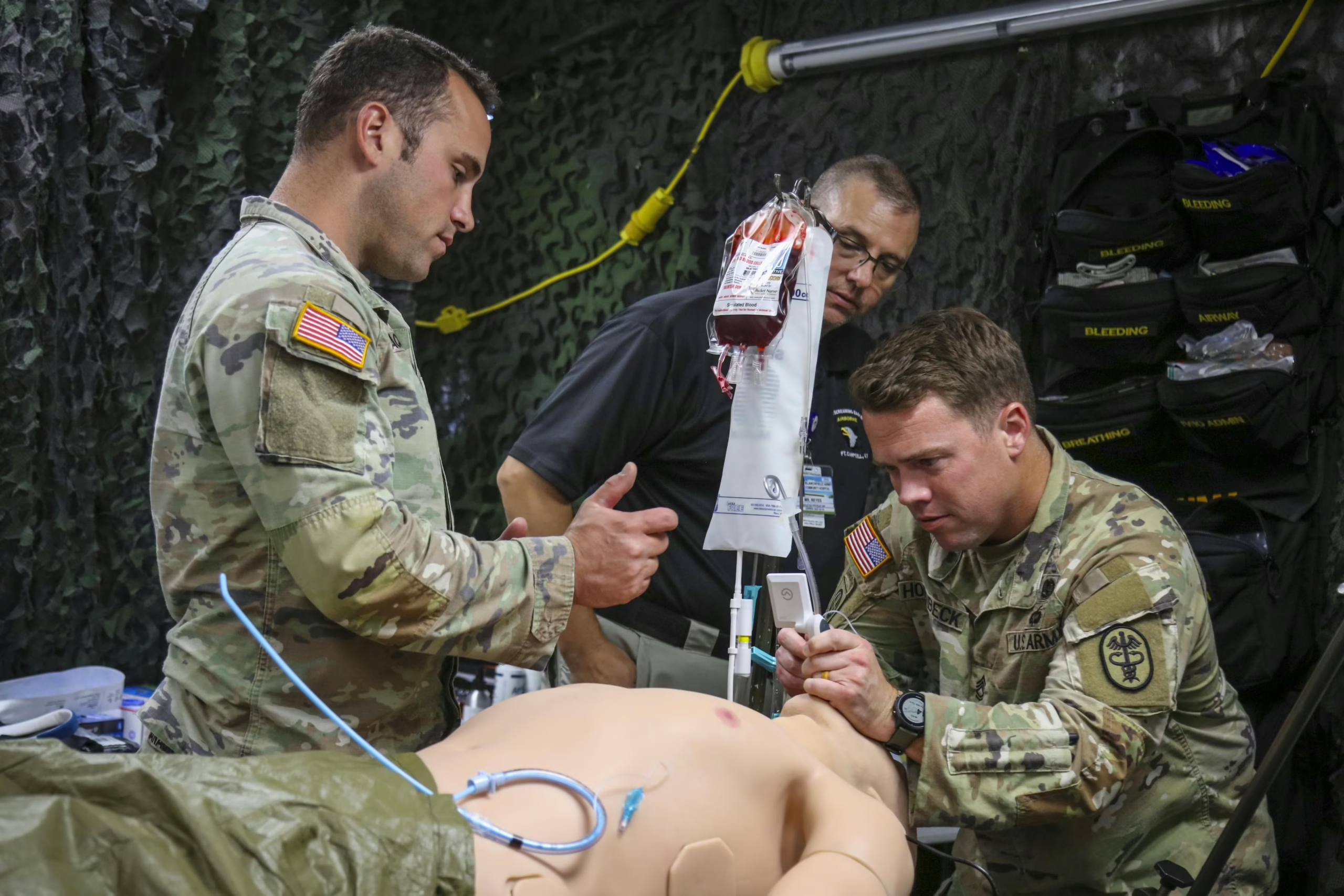
Battlefield medicine has improved markedly since Vietnam, yet one problem remains stubborn and deadly. Internal bleeding inside the torso, known in clinical terms as non-compressible torso hemorrhage, continues to produce a very high fatality rate because frontline medics cannot control it with tourniquets or dressings. The Defense Advanced Research Projects Agency has launched the Medics Autonomously Stopping Hemorrhage program, or MASH, to address that gap with robotic systems that can detect, navigate to, and arrest internal bleeding with minimal human input.
Why this problem matters now is straightforward. Modern combat produces blast and penetrating injuries that rupture vessels deep in the abdomen and pelvis; those bleeds are often lethal within minutes if not surgically controlled. Studies of combat casualties show extremely high case fatality rates for non-compressible torso hemorrhage, and clinical practice has had only limited options at far-forward locations. Resuscitative endovascular balloon occlusion of the aorta, or REBOA, and other endovascular techniques can buy time in hospital or echeloned care; however, they require trained specialists and an equipped surgical environment. DARPA’s MASH aims to provide an earlier layer of intervention that can stabilize casualties long enough to reach advanced care.
MASH is deliberately ambitious. The program will pursue sensor suites, navigation algorithms, robotic manipulators, and medical instruments that act together in austere settings. DARPA frames the project as developing a GPS for the inside of the human body: a system that maps organs and vascular structures in real time, finds the active bleed, and positions hemostatic tools to stop it. The architecture anticipates two development phases over three years; the first concentrates on sensor-robot integration to detect bleeding, and the second develops autonomy software to perform interventions with constrained human oversight. DARPA has scheduled a virtual proposers day for September 18, 2025 for teams interested in contributing.
Technically, the program sits at the intersection of several hard problems. Locating an internal arterial bleed means detecting flowing blood through a noisy tissue environment; that will demand multimodal sensing such as ultrasound, optical spectroscopy, and possibly acoustic or electromagnetic sensors combined with advanced signal processing. Navigating a robotic tool inside a torso requires registration between sensor data and a model of anatomy, plus motion planning that avoids organs and vital structures. The control stack must run on edge hardware that tolerates vibration, dust, and intermittent power; it must also operate under constraints of communication delay or loss, because combat medics often work beyond reliable network coverage. Each of these elements has precedent in civilian research but not in an integrated, field-worthy package.
Intervention methods that a robotic system might employ are drawn from contemporary trauma care. Endovascular techniques such as REBOA temporarily occlude the aorta to limit distal bleeding and have been used in military and civilian trauma settings to buy transport time to definitive surgery. Direct focal hemostatic tools, including targeted electrocautery, microwave coagulation, or deployable embolic devices delivered to a bleeding vessel, are also possibilities. A successful MASH demonstrator will need to combine accurate localisation with a minimally invasive access strategy and fail-safe modes that prevent catastrophic collateral damage. The program will therefore be judged not only on hemostatic efficacy but on safety envelopes, human supervisory interfaces, and ease of use by non-surgeon medics.
Robotic and autonomy research already offers partial templates for what DARPA describes. Laboratory projects and prior DARPA efforts have explored teleoperated surgical robots, semi-autonomous instrument guidance, and remote supervision of procedures. The Trauma Pod concept and related work at research labs have shown that robots can assist or execute constrained surgical tasks when supplied with robust sensing and human oversight. The new program, however, shifts emphasis from teleoperation to higher levels of autonomy suited to chaotic, time-critical battlefield conditions. That requires rigorous testing in realistic, signal-denied, and physiologically variable scenarios.
Operational constraints will shape what is feasible. Weight and volume matter for medics who already carry fuel, ammunition, and lifesaving consumables; power and sterilization logistics affect how many missions a device can support; and environmental hardening governs whether sensors and actuators survive dust, heat, and shock. Equally important are clinical and ethical considerations: any autonomous intervention on a human body must meet high standards for verification and validation, and commanders and clinicians will need clear rules of engagement about when autonomy may act and when explicit human consent or command is required. Legal, regulatory, and medical liability frameworks will need rapid adaptation if these devices are to leave the laboratory. These issues are solvable but they require more than a good algorithm; they require a programmatic pathway that integrates training, doctrine, supply, and clinical governance.
DARPA’s choice to make the system as user-friendly as an automated external defibrillator establishes a useful design bar. AEDs allow non-medical personnel to intervene because they embed sensing, decision rules, and simple user prompts; they also rely on well-established physiology and short, well-defined actions. MASH aims for a comparable degree of simplicity in operation while addressing a far more complex physiology. Translating complex surgical reasoning into robust, limited autonomy is the core engineering and medical task. The AED analogy serves to remind program planners that human factors and intuitive interfaces are as important as sensor fidelity.
Potential operational benefits are clear. If MASH-class systems can stabilize a casualty for 24 to 48 hours, the logistics of evacuation and surgical prioritization change. Units operating in distributed, contested environments would gain a buffer that reduces mission disruption and improves survival odds. That said, prototypes must demonstrate durable performance across casualty types and populations, because injury patterns in large-scale conflict may differ from recent small-scale engagements. DARPA’s emphasis on rapid prototyping and a proposers ecosystem aims to accelerate iteration and reveal failure modes early through empirical testing.
For researchers and companies, the program is an invitation and a warning. Success will demand cross-disciplinary teams that combine trauma surgery, interventional radiology, robotics, sensing, autonomy, and field medicine logistics. It will also demand robust clinical trials and independent verification that respect both human subject protections and the realities of military medicine. The virtual proposers day on September 18, 2025, will be the formal opening for interested parties to align capabilities and form teams; that event is likely to shape which architectures advance into hardware demonstrations.
DARPA’s MASH program projects a future in which frontline care is not only faster but more capable, where a casualty’s first definitive intervention may occur close to point of injury through autonomous systems that combine sensing, robotics, and medical know-how. Realizing that future will require hard engineering, careful clinical science, and policy that balances battlefield utility with human safety. If those pieces come together, the program could change how armed forces and emergency responders think about the interval between injury and surgery; for now, MASH is a bold attempt to convert decades of surgical and robotic research into a tool that can save lives where time and distance are the enemy.
